Tarasca
France
Tarascon, on the left bank of the Rhône (Bouches-du-Rhône), lower Provence
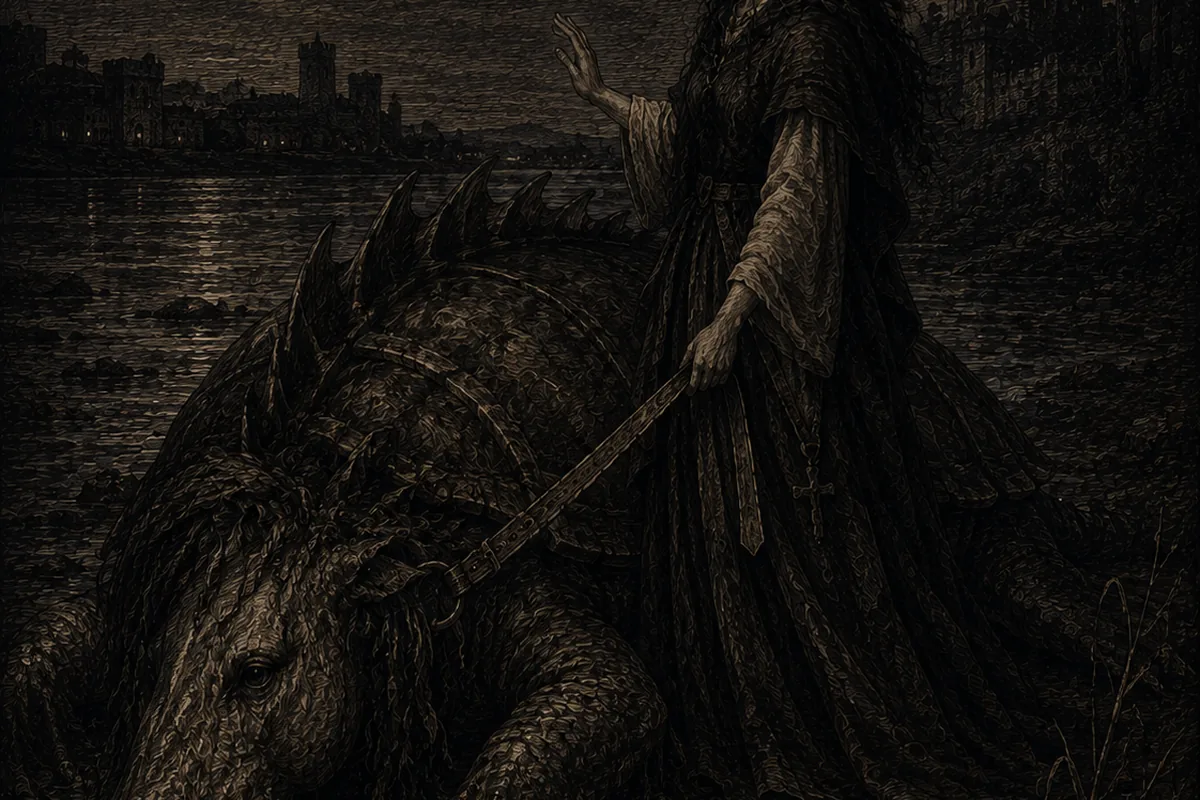
Tarasca — an amphibious monster lurking in a wood on the bank of the Rhône, which devoured passers-by and sank boats.
- Variants and names
- Provençal la Tarasca, French la Tarasque; the festival is the Fête de la Tarasque
- What is told
- An amphibious monster lurking in a wood on the bank of the Rhône, which devoured passers-by and sank boats. In the oldest version it is the offspring of Leviathan and of the Bonnacon of Galatia, half fish, with an equine mane, a back as sharp as an axe blade and a tail made up of one hundred and eighty-five vipers; in the rewriting that made it famous it has six legs and the shell of a tortoise. Saint Martha, arrived from Palestine, finds it while it is devouring a man, sprinkles it with holy water, shows it the cross and binds it with her own girdle. At that point the monster lets itself be led meekly into the town — and it is the populace, not the saint, that kills it. Since then the town has borne its name, and every year a great articulated effigy is carried through the streets.
- What it was forthe author’s reading
- It is the rite by which a town tells itself its own foundation and stages it every year. The processional dragon — which has many sisters in Europe, from Spain to Flanders — makes it possible to parade together the tamed chaos and the community that masters it, with the Church guaranteeing the victory and the young men of the town working the monster. That in the legend it is the populace that finishes off the beast, and not the saint, is not a detail: the town claims its own part in its own myth.
- Where it is attested
- The oldest redaction is the Vita sanctae Marthae of Pseudo-Marcilia, datable to between about 1174 and 1210; the version that went round Europe is the abridged one in the Legenda aurea of Jacobus de Voragine, around 1260. A processional dragon is already mentioned in a municipal deliberation of Tarascon of 1465. The standard ethnographic study: Louis Dumont, La Tarasque. Essai de description d'un fait local d'un point de vue ethnographique, Gallimard, 1951; on the relationship between King René and the festival, Noël Coulet, 1991. The festival is today a component of the multinational element on processional giants and dragons, proclaimed a Masterpiece of the Oral and Intangible Heritage in 2005 and incorporated into the UNESCO Representative List in 2008.
- Caution
- Grade A for the documentary core, which is of the first order: hagiographic manuscripts with a critical edition, fifteenth-century municipal deliberations, an academic ethnographic monograph. The things to be corrected are almost all in the tourist version. The first attestation is not the Legenda aurea but Pseudo-Marcilia, almost a century older. Saint Martha does not kill the Tarasca: she tames it. The date 14 April 1474 as the foundation of the festival by the will of King René is a nineteenth-century reconstruction, judged groundless by Noël Coulet in 1991, and a processional dragon is documented as early as 1465. The festival has not been unbroken since the fifteenth century: it has been suppressed, resumed and reinvented several times, and the present arrangement dates from 1946. The name of the town does not come from the monster: the place name is ancient and pre-Latin, and it is the legend that was born from the name, not the other way round. Finally the so-called «Tarasca of Noves», a Celto-Ligurian sculpture of a man-eating monster found in 1849 and kept at Avignon, has no documented relationship with the Tarasca of Tarascon: the name was given to it by the scholars of the nineteenth century, and ever since it has furnished the thesis of a continuous pagan cult with a material proof that proves something else.
The grade says how well the entry is documented, not how interesting it is. How the grades are assigned.