Ankou
France
Lower Brittany: Trégor, Goëlo, Léon and Breton Cornouaille, with the collecting nucleus at Port-Blanc
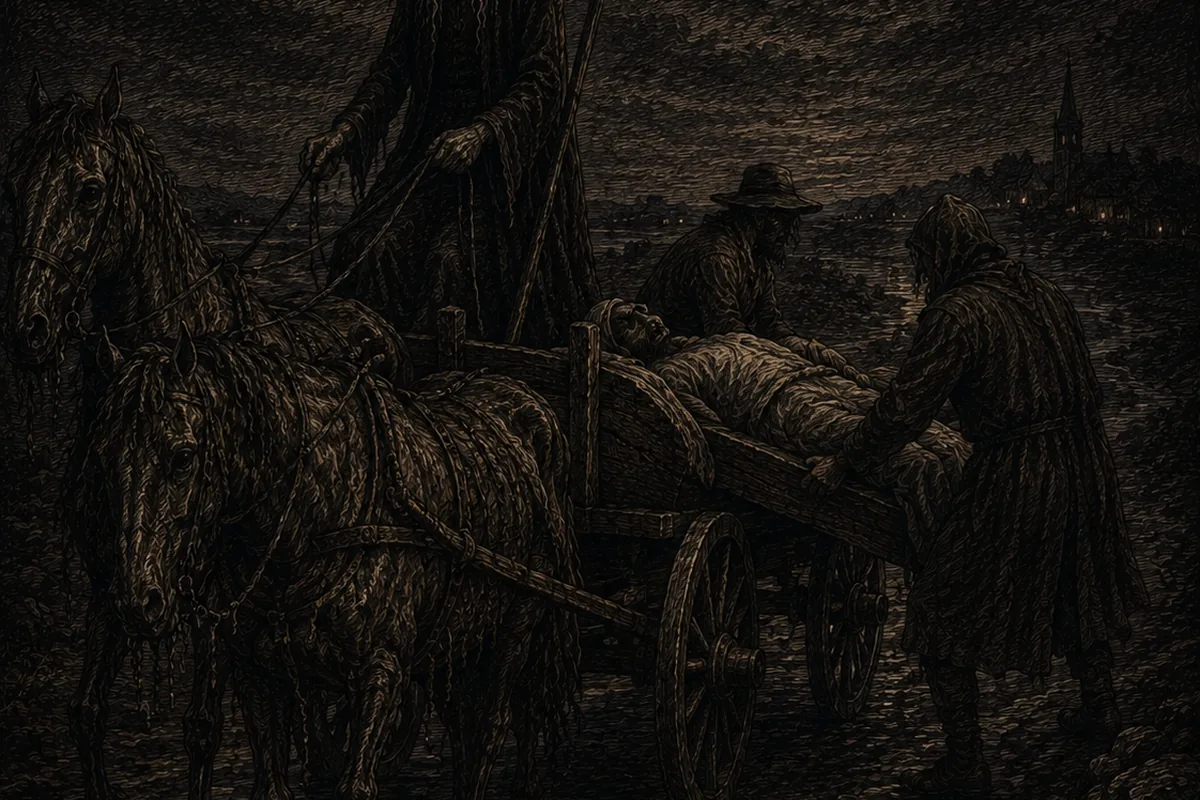
Ankou — the carter of death in Brittany: not the Death that decides, but the one that carries out and collects the year's dead.
- Variants and names
- Breton an Ankou, «the workman of death» (oberour ar maro); the cart is karrigell an Ankou, and in the first printed attestation of 1799 cariquel-ancou. Cognates: Cornish an Ankow, Welsh yr Angau
- What is told
- He is not the Death that decides, he is the one that carries out: the Ankou is the carter charged with collecting the dead of the parish. He appears as a very tall, thin man with long white hair, his face in shadow under a wide felt hat, or else as a skeleton wrapped in a shroud, with the head turning continually on the spinal column like a weathervane, so as to keep watch over the whole territory. He carries a scythe with the edge turned outwards, which he does not draw towards himself as reapers do but casts forward. The cart is drawn by two horses in file, one exhausted and one sturdy, and two companions accompany him: one leads the lead horse, the other opens the gates and loads the dead. He is not seen: he is heard. The creaking of the badly greased axles — wik! wik! — announces a death, according to some versions three nights in advance.
- What it was forthe author’s reading
- It gives death a role and a timetable instead of a meaning. The Ankou does not judge, does not punish and does not console: he does a job, with a peasants' cart and peasants' tools. In a society where mortality was constant and collective, the figure shifts attention from the why to the when, and offers the community a shared system of omens — a creak, a dog howling, a lamp going out — that makes death announceable and therefore socially manageable. That the office lasts a year and passes to the next person to die further ties him to the calendar of the parish, that is, to common time.
- Where it is attested
- The word is attested as early as around 850 in an Old Breton gloss, as an abstract noun for «death» (L. Fleuriot, Dictionnaire des gloses en vieux breton); as a character who speaks in the first person he appears in the 14th century in the Middle Breton mystery play Buhez Santes Nonn; the headword is in the Catholicon of Jehan Lagadeuc, composed in 1464 and printed at Tréguier in 1499. The cart is in print from 1799, in Jacques Cambry, Voyage dans le Finistère. The canonical collection is Anatole Le Braz, La Légende de la mort en Basse-Bretagne, Honoré Champion, 1893, with a preface by Léon Marillier; the second edition, recast and enlarged, appears in 1902 under the title La Légende de la mort chez les Bretons armoricains with the notes of Georges Dottin. More than a hundred of Le Braz's field notebooks are at the Centre de recherche bretonne et celtique in Brest.
- Caution
- Grade A holds for the figure and for its textual history, which is documented better than almost any other entry in this atlas. It does not hold for the explanation that circulates everywhere. Four clarifications. Le Braz is not the first attestation but the first systematic collection: the cart is in print almost a century before him, the word a thousand years before. The title La Légende de la mort chez les Bretons armoricains with the date 1893 is a conflation widespread even in serious bibliographies: in 1893 the title was en Basse-Bretagne. The rule by which the last person to die in the year becomes the Ankou of the parish is the Trégor variant, raised to a Breton norm by Le Braz: elsewhere it is the first to die in the year. And the figures carved on the ossuaries — Ploumilliau, La Roche-Maurice, La Martyre — depict the Death of the late-medieval European repertoire: the name Ankou is a regional label applied after the fact. The limit of the principal source must be stated as well: Le Braz was a writer, and his contemporaries already remarked how literarily he treated the material collected from dictation.
The grade says how well the entry is documented, not how interesting it is. How the grades are assigned.