Rougarou
the United States
French-speaking Louisiana: Acadiana and the Creole area of New Orleans
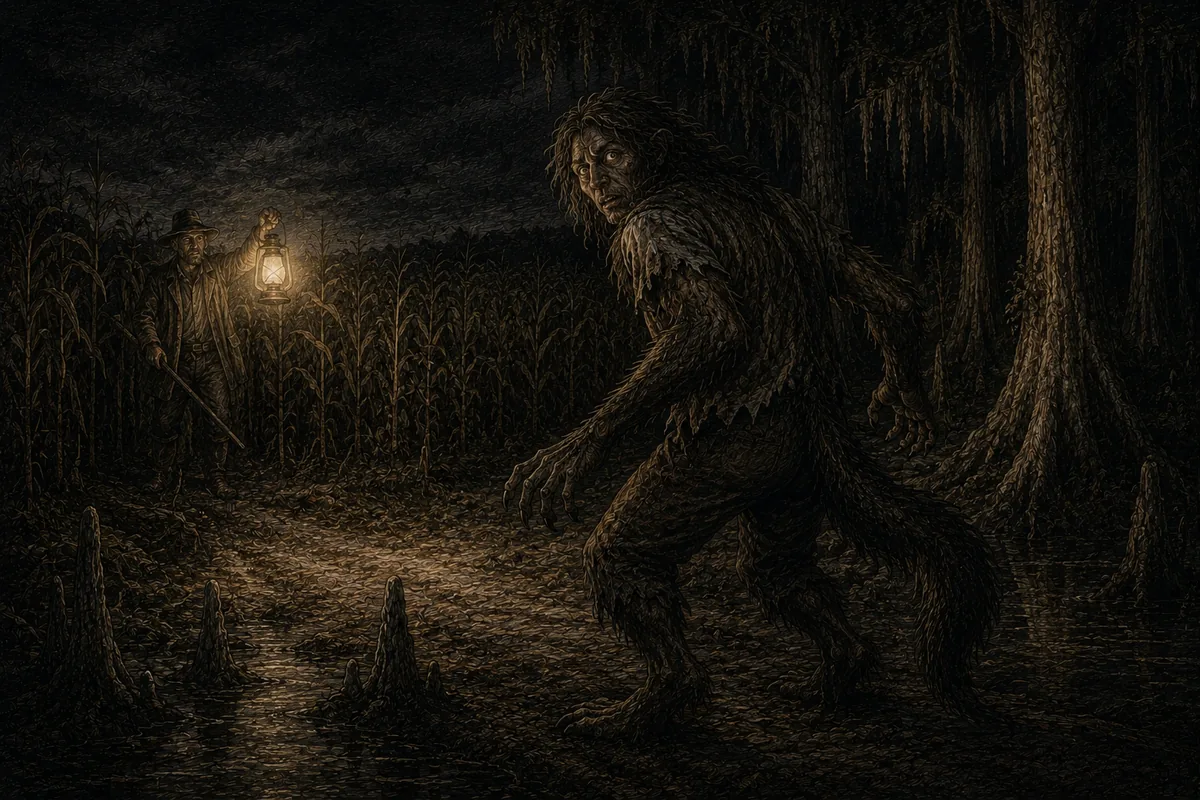
Rougarou — a man turned into a wolfish beast who roams at night in the swamps, the cypress groves and the sugar cane fields.
- Variants and names
- rougarou, roux-ga-roux, rugaroo, rugaru; standard French form loup-garou, still in use among older speakers
- What is told
- A man turned into a wolfish beast who roams at night in the swamps, the cypress groves and the sugar cane fields. In the versions collected in Louisiana the curse lasts 101 days, and to be freed of it one must wound the rougarou and make it bleed, but whoever has seen it and speaks of it within a year and a day becomes a rougarou in turn. In a Catholic variant, anyone who fails to observe Lent for seven consecutive years is transformed, and the rougarou itself hunts Catholics who break the abstinence. A typical countermeasure is to leave seventeen small objects outside the door, because it cannot count beyond twelve and stays stuck there until dawn.
- What it was forthe author’s reading
- It serves for the disciplining of children, and it is still more alive today as a supernatural sanction of Lenten observance in a French-speaking Catholic society, and from the 1980s and 1990s as an identity marker of the Cajun cultural claim against anglophone assimilation.
- Where it is attested
- The loup-garou complex is exhaustively documented in France and in New France from the late Middle Ages; the Louisiana branch arrives with French settlement and with the Acadian Grand Dérangement of 1755-1764. Barry Jean Ancelet, University of Louisiana at Lafayette, the leading academic authority on Cajun folklore, confirms that the story is a widespread and living legend throughout French-speaking Louisiana; the reference corpus is in his collections, in the materials of the Louisiana Folklife Program and in the oral archives of UL Lafayette. The etymology is secure: loup plus garou, from Frankish werwulf, a tautological compound.
- Caution
- I have not found a first written attestation specifically from Louisiana with a certain date in an accessible academic source: the dates that circulate in popular accounts are generic, and this is the weak point of the entry. The most frequently cited details, that is the 101 days, the seventeen objects and the year and a day of silence, are attested orally, but their publicly verifiable documentation is late and predominantly popular. The rugaru of the Métis and of the northern Plains must also be kept distinct: a related word but a different complex of beliefs, often confused with the Wendigo.
The grade says how well the entry is documented, not how interesting it is. How the grades are assigned.