Boo hag
the United States
Gullah Geechee Lowcountry, Sea Islands of South Carolina and Georgia
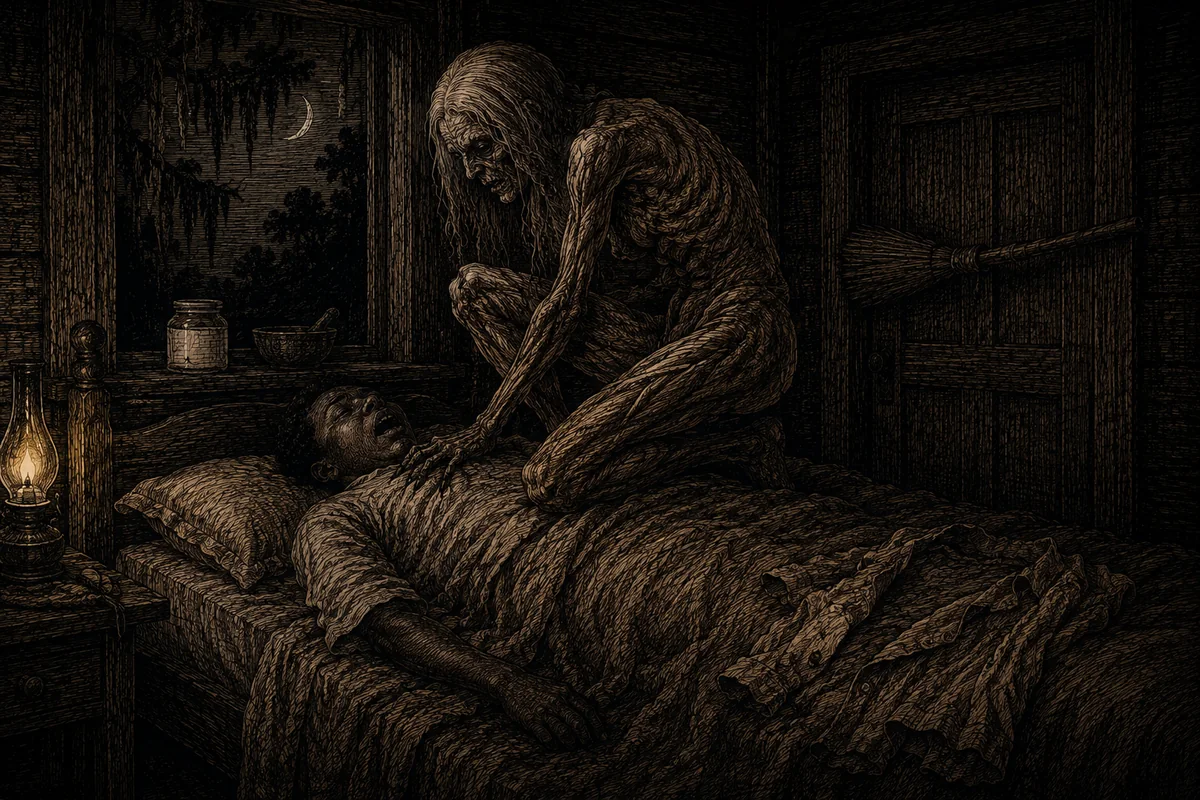
Boo hag — the boo hag is skinless, red and slimy; by day she wears a stolen human skin and lives in the midst of the community without arousing suspicion.
- Variants and names
- boo hag; in the earliest sources simply hag or witch; local proverbial formula «Don't let de hag ride ya»
- What is told
- The boo hag is skinless, red and slimy; by day she wears a stolen human skin and lives in the midst of the community without arousing suspicion. At night she slips it off and flies, entering the house through a crack or down the chimney, and she does not drink blood but sucks the breath and the vital force. She rides the sleeping victim, who wakes exhausted and paralysed; the saliva run down the cheek was interpreted as the bridle with which the witch has ridden. Documented countermeasures are salt and cayenne pepper, a broom or a sieve to be counted until dawn, and haint blue on doors and windows.
- What it was forthe author’s reading
- It supplies an aetiology for a real and terrifying physiological experience, sleep paralysis with the hallucination of a weight on the chest. It also works as an instrument of social control, because the hag is always a neighbour, and as a cautionary tale for children.
- Where it is attested
- Jacob Stroyer, Sketches of My Life in the South, Salem Press, 1879, which explicitly records the motif of the saliva as a bridle; Drums and Shadows, Georgia Writers' Project, 1940; WPA Slave Narrative Collection, 1936-1938, Library of Congress. Institutional context in the Gullah Geechee Cultural Heritage Corridor, 2006.
- Caution
- The hag-riding complex is of grade A and is excellently documented from 1879 to 1940, but the figure codified under the fixed name boo hag and with the stolen skin as a central element only becomes settled in the second half of the twentieth century, through children's literature and the ghost tours of Charleston: for this reason the overall grade is B. The WPA sources speak of hags and witches, not of boo hag as a technical term. The African etymologies attributed to the compound that circulate online are not established.
The grade says how well the entry is documented, not how interesting it is. How the grades are assigned.