Shuigui
China
Riverine and coastal China; the canonical tale is set in Zhaoyuan county, Shandong
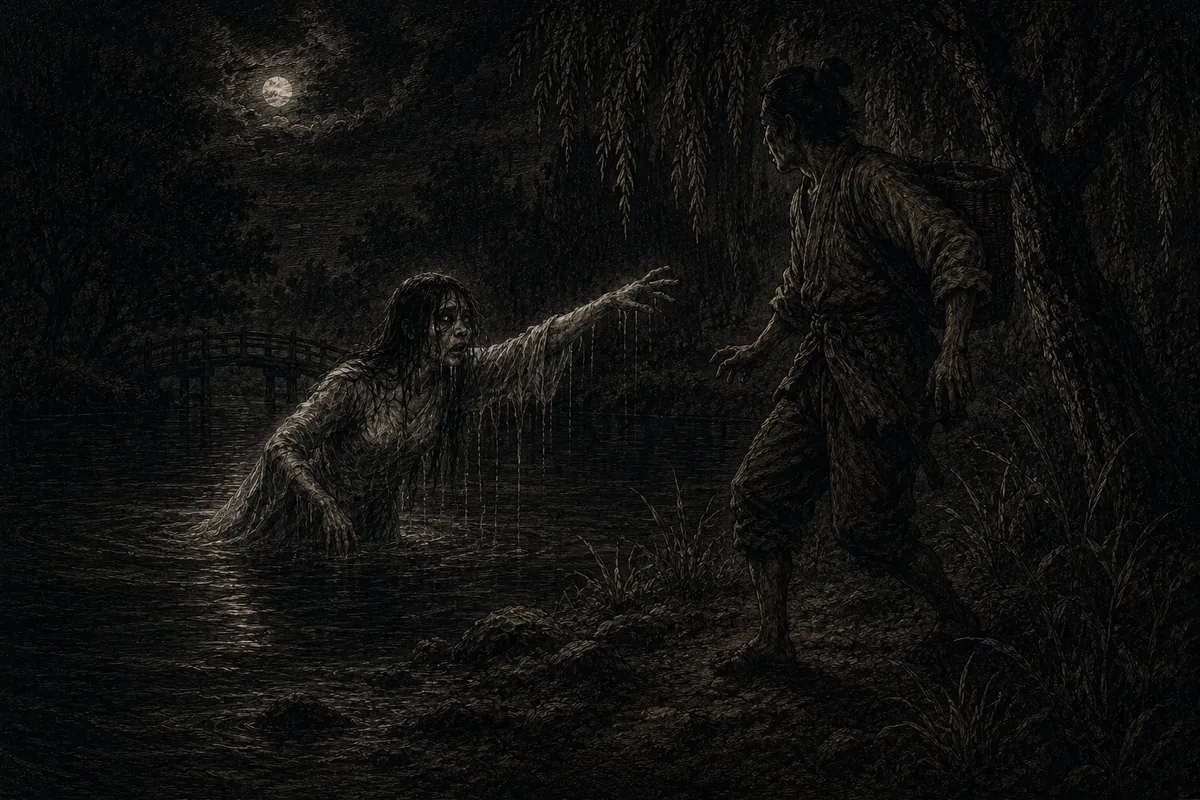
Shuigui — the Chinese ghost of the drowned, who cannot be reborn until another dies in the same way and at the same spot.
- Variants and names
- Chinese 水鬼 shuǐguǐ, «water ghost»; also luòshuǐguǐ, nìsǐguǐ. The act that defines it is 找替身 zhǎo tìshēn, «to seek a substitute», which in Min Nan and in Taiwan is 抓交替 zhuā jiāotì; hence tìsǐguǐ, today a current idiom for «scapegoat». When the water dead are deified they take benign names: shuǐliúgōng, wànshàn yé
- What is told
- Whoever drowns cannot be reborn until another dies in the same way and at the same spot, taking his place. The water dead therefore remain bound to the place and drag under the living who come near it. The same rule applies in parallel to the hanged, who induce others to hang themselves from the same beam. It is not a monster: it is a human dead person, often pitied, and a part of the corpus deifies him as a protector.
- What it was forthe author’s reading
- A double function. Deterrence: the story marks the dangerous points of water and makes them taboo. And moral consolation, because the cycle is broken by an act of pity — in the best-known tale the ghost gives up his own substitute out of pity for a child, and precisely for this is promoted to tutelary deity of the village. The narrative message is not «the ghost will take you», but «giving up the substitute is what redeems you».
- Where it is attested
- Song attestations in the Xinbian fenmen gujin leishi. The key text is Pu Songling, Liaozhai zhiyi, first juan, Wang Liulang: a fisherman pours wine into the river so that the drowned ghosts may drink; the ghost announces to him the arrival of his own substitute, then gives it up — «I pitied the child she held in her arms: to replace me alone, I should have put out two lives». Also Shuimang cao, in the same collection, and entries in Ji Yun. The belief is documented as news reporting already in the colonial press: Taiwan nichinichi shinpō, 19 April 1906. Rites for the pacification of the waters are still performed, among them the release of the souls at Kouhu in Yunlin, for the victims of the flood of 1845, designated important folklore in 2008.
- Caution
- It should be made clear what this belief is not. It is not Buddhist doctrine: no canonical text provides for the rule of the substitute, and the Buddhist and Daoist clergy intervened if anything with rites of release in order to break the cycle. It does not concern water alone, because it holds also for the hanged and the poisoned. And it is not an exclusively Taiwanese motif: the documentation from Taiwan is the richest — university investigations of the Meilin creek case, rites on the embankments at Yilan and at Tainan — but the belief is continental and at least Song. Finally, the shuigui and the shuǐhóuzi, the «water monkey» of the South, are to be kept distinct: the latter is an amphibious cryptid and not a human dead person: they are two superimposed strata.
The grade says how well the entry is documented, not how interesting it is. How the grades are assigned.