Wendigo
Canada
Algonquian Subarctic, Oji-Cree and Severn area; the densest archival file comes from Sandy Lake, north-western Ontario
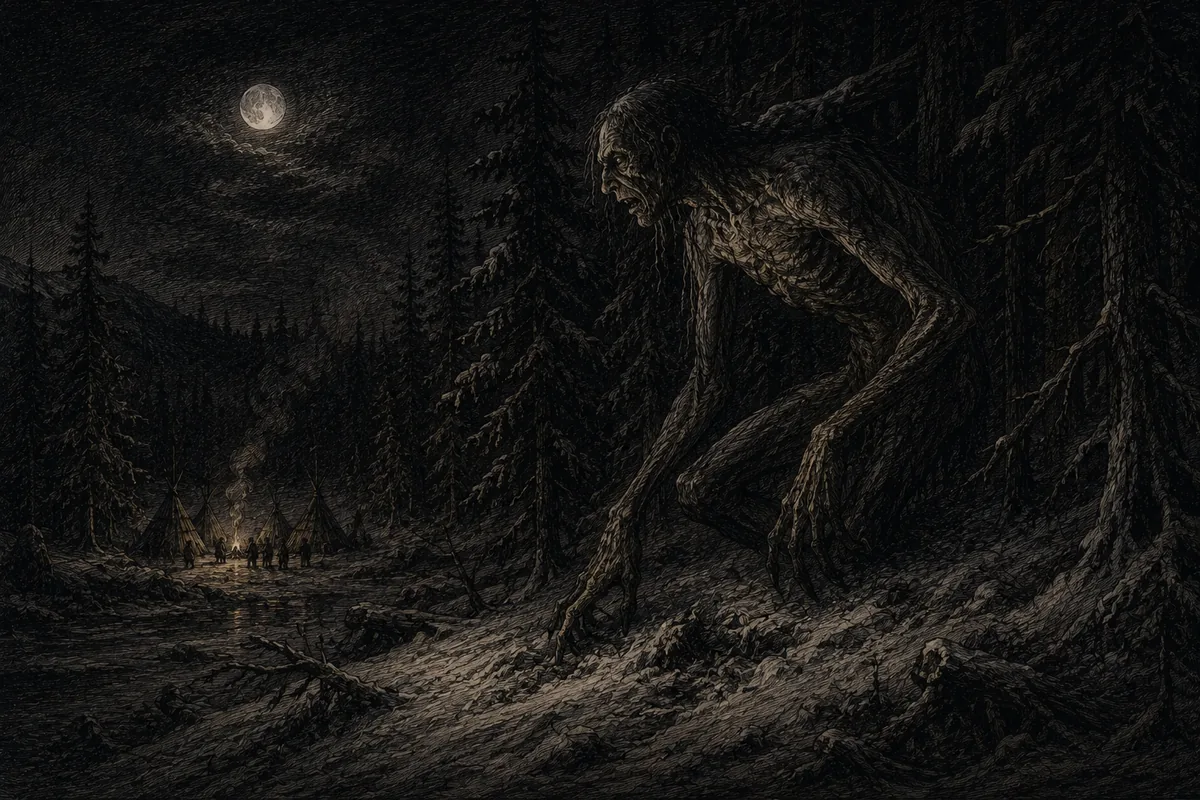
Wendigo — in Subarctic Algonquian societies at once a being bound to winter and to hunger and a condition into which a person may fall.
- Variants and names
- Cree wîhtikow (in syllabics ᐐᐦᑎᑯᐤ), plural wîhtikowak; Eastern Cree wîhtikû; Ojibwe and Anishinaabemowin wiindigoo, plural wiindigoog. In the early sources witiko, wetiko, wihtiko. «Wendigo» is the anglophone rendering, fixed by Algernon Blackwood's story of the same name in 1910. To be kept distinct, and not cognate: the Innu atshen and the Mi'kmaq chenoo, which the colonial sources assimilated for convenience
- What is told
- In Subarctic Algonquian societies the term denotes at once a being — associated with winter, with frost, with hunger — and a condition into which a person may fall: insatiable appetite, aversion to ordinary food, progressive removal from the human. The two conceptual poles are the transgression of cannibalism and transformation, and the category functions as the moral boundary of the person, not as a monster like any other. Beyond this this entry does not go: the rest is the communities' own material, and its circulation is for them to decide.
- What it was forthe author’s reading
- Scholars give three readings of it, all interpretative and in part contested by the communities themselves. A psychological one, which sees in it the projection of famine anxiety. A materialist one, which reads it as a device for legitimating the elimination of unproductive members under food stress. And a semantic-ethical one, today the most widespread in indigenous circles, which makes of it the figure of insatiable greed and rereads it as a critique of consumption and of colonisation.
- Where it is attested
- The written documentation is abundant, dated and continuous, but almost all of it colonial: Jesuits, traders, police, courts. The earliest secure passage is in the Jesuit Relation of 1661, which describes people seized by «a hunger more than canine» who devour others «like veritable werewolves» — with the European demonological frame plainly visible. The mention of 1636 that circulates in all the encyclopaedias is not verified: looking for it in the corresponding volume of the Thwaites edition, it does not appear. Then the post journals of the Hudson's Bay Company from the eighteenth century, with the first English attestation «Whitego» in 1714, and the nineteenth-century missionary lexicography that fixed the spellings. In the twentieth century: Saindon 1928, Cooper 1933, Landes 1938, Hallowell 1955, Teicher 1960, then Marano 1982, Brightman 1988, Waldram 2004, Carlson 2009.
- Caution
- Grade B has nothing to do with the quantity of documentation, which would warrant A, but with its nature and with the decision not to set everything out. The sources are almost entirely colonial and mediated; the supposed first attestation does not survive checking; and the traditional content is living and in part restricted, so what is described here is its context and the history of its collection, not the repertoire. High documentation, deliberately partial content. To be corrected, because it is by now everywhere: the cervid skull and the antlers come from cinema and video games, not from the tradition. The etymology «spirit that devours» is invented; serious linguistic reconstruction proposes a Proto-Algonquian form that would mean «owl», and it remains uncertain. And the commercial and horror use of the name is contested by Cree and Anishinaabe speakers: it is not a public-domain monster, and it is one of the few entries in this atlas in which the manner of telling it is itself a matter of dispute.
The grade says how well the entry is documented, not how interesting it is. How the grades are assigned.