Bestia del Gévaudan
France
Margeride, between Gévaudan and southern Auvergne (Lozère, Haute-Loire, Cantal), with the opening episode in Vivarais
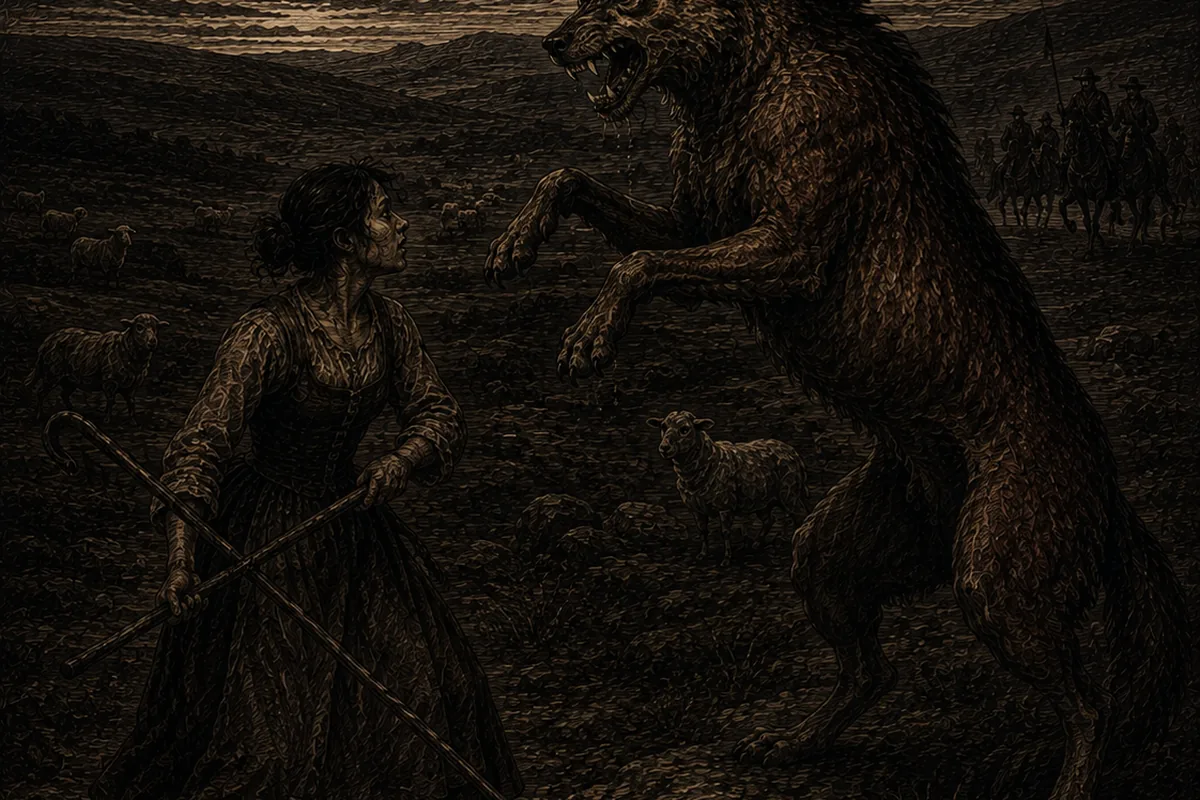
Bestia del Gévaudan — between June 1764 and June 1767, on the plateau of the Margeride, an animal — or more than one — kills dozens of people, the overwhelming majority of them women, girls and children caught alone at pasture.
- Variants and names
- la Bête, la bette féroce in the burial record of 1 July 1764, le monstre; modern Occitan la Bèstia de Gavaudan. The formula «Beast of Gévaudan» becomes fixed through the press in the course of 1765: it is a journalistic label, not a local name
- What is told
- Between June 1764 and June 1767, on the plateau of the Margeride, an animal — or more than one — kills dozens of people, the overwhelming majority of them women, girls and children caught alone at pasture. In contemporary accounts it is larger than a wolf, with a broad chest, reddish fur and a dark stripe along the back, able to rear up on its hind legs. Louis XV sends first the dragoons of Captain Duhamel, then the Norman wolf-hunter d'Enneval, and finally his own gun-bearer François Antoine, who on 20 September 1765 brings down the large «wolf of the Chazes» and takes it stuffed to Versailles. The attacks resume in December. They end on 19 June 1767, when Jean Chastel brings down a large canid during a hunt held by the Marquis d'Apcher at Mont Mouchet.
- What it was forthe author’s reading
- The «Beast» in the singular, monstrous and named, gives a single face to a diffuse and structural mortality: wolf predation on child shepherds was an ordinary fact of rural France, and precisely for that reason invisible. Turning it into a monster allows the community to obtain troops, bounties and exemptions, the monarchy to stage the protection of its subjects, and the bishop of Mende to inscribe the affair in the scheme of divine scourge and collective penance. It is the mechanism by which an everyday risk becomes tellable only when it ceases to seem everyday.
- Where it is attested
- Parish burial registers held at the Archives départementales of the Lozère, the Haute-Loire, the Cantal and the Ardèche — the record of the first victim, Jeanne Boulet, fourteen years old, is of 1 July 1764 and says she was killed «par la bette féroce»; correspondence of the intendants and ministry papers; procès-verbal of the kill of September 1765 and autopsy report of the surgeon Marin, 20 June 1767; mandement of the bishop of Mende, 1 January 1765; contemporary periodical press, from the Gazette de France to the Courrier d'Avignon. Studies: Jean-Marc Moriceau, Histoire du méchant loup, Fayard, 2007, and his works on wolf predation; Jay M. Smith, Monsters of the Gévaudan, Harvard University Press, 2011.
- Caution
- It is the opposite case to almost everything else in the atlas: not an oral tradition collected late, but an event over-documented by the administration while it was happening. Grade A concerns the facts; the received version that surrounds them is twentieth-century and of a far lower grade. The figures vary — about 80 dead on the restrictive count from official documents, a hundred or more with broader criteria, about 230 adding the wounded and the survivors — because the counts measure different things, because nothing proves that every victim recorded is attributable to the same cause, and because after September 1765 the royal power has an interest in saying no more about it: 1766 is the worst-documented year, and the attacks were continuing. To be corrected: the silver bullet appears in no source of 1767 — it is born in a novel by Élie Berthet of 1858 and takes its known form with Henri Pourrat in 1946; Chastel was not rewarded by the king but received 72 livres from the diocese, and his family was still claiming the balance in 1793; the first victim was not killed in Gévaudan but in Vivarais.
The grade says how well the entry is documented, not how interesting it is. How the grades are assigned.