Kappa
Japan
The whole archipelago, with documentary poles at Tōno in Iwate, in Kyūshū and at Asakusa in Tokyo
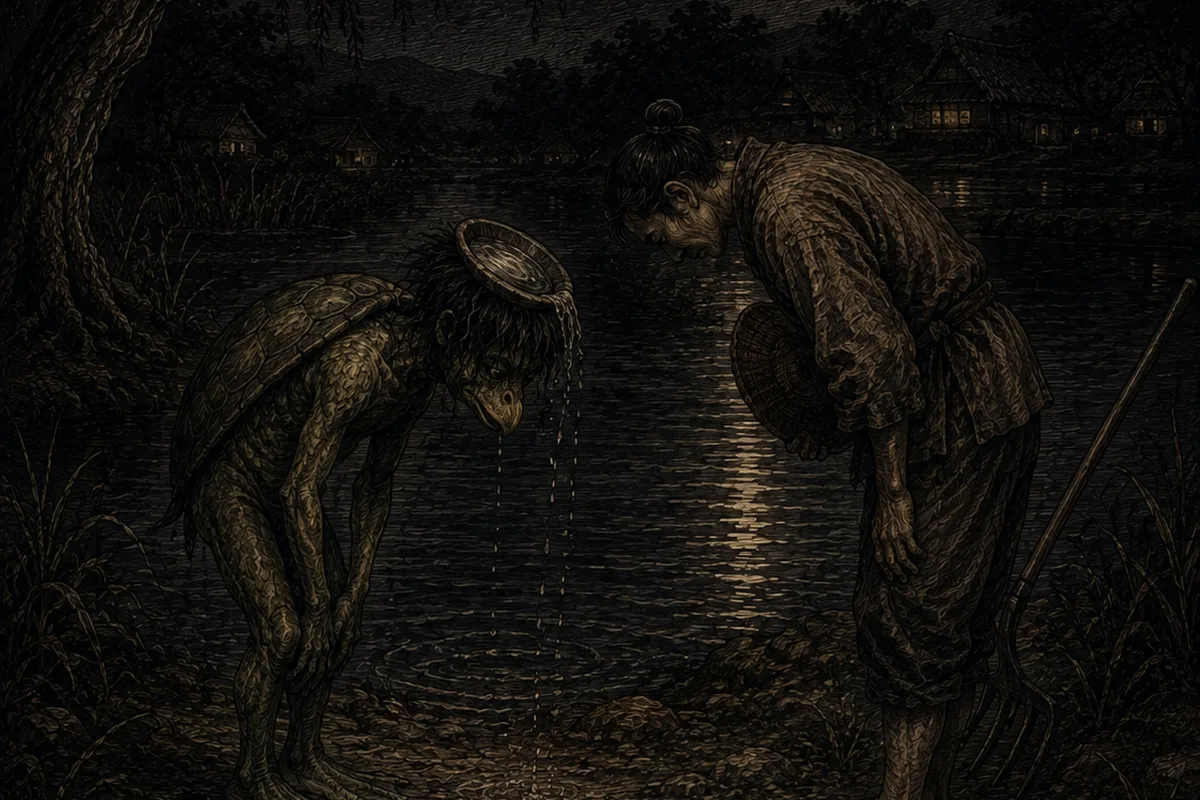
Kappa — as tall as a child, greenish, with webbed hands and feet, a tortoise carapace and a beak.
- Variants and names
- kappa, standard in eastern Japan; more than eighty regional names, among them kawatarō and kawako in the west, gatarō in the Kansai, enkō in Chūgoku and Shikoku, garappa at Kagoshima, hyōsube in southern Kyūshū, medochi in northern Tōhoku, mizushi, suiko
- What is told
- As tall as a child, greenish, with webbed hands and feet, a tortoise carapace and a beak. The decisive feature is the sara, the hollow on the top of the head that holds water: if the water spills the kappa loses its strength or dies, whence the classic countermeasure of bowing deeply, because out of courtesy it will return the bow and empty its head. It drags children, horses and cows underwater and extracts the shirikodama, a mystical sphere situated in the anus, the loss of which is fatal; it loves cucumbers, vinegar and sumō. It is absolutely bound by a promise given, and many tales tell of a captured kappa which in exchange for its freedom swears to do no more harm or teaches the setting of fractures.
- What it was forthe author’s reading
- Prevention of drownings, a primary and openly acknowledged function in a country of rice paddies, irrigation canals and torrential rivers, and explanation of the loss of livestock at the fords. It also ritualises the relationship with irrigation water, a vital and contested resource, given that the offerings of cucumbers to the kappa are in substance offerings to the suijin, the divinity of water, and it legitimises local therapeutic knowledge through the traditions of the kappa as physician.
- Where it is attested
- Yanagita Kunio, Tōno Monogatari, 1910, founding text of Japanese folklore studies; Yanagita again for the thesis, still dominant, that the kappa is a suijin demoted from god to monster. Edo repertories: Wakan Sansai Zue, 1712, and Toriyama Sekien, Gazu Hyakki Yagyō, from 1776, which canonise yōkai iconography. Komatsu Kazuhiko, Nichibunken of Kyoto, with a yōkai database; Michael Dylan Foster, Pandemonium and Parade, 2009, and The Book of Yōkai, 2015. Living rites: the Sōgenji temple or Kappa-dera at Asakusa with offerings of cucumbers, the Kappa-buchi at Tōno, the Oregadanaha Kappa Matsuri at Yatsushiro in summer, local festivals at Ushibuka and Ushiku.
- Caution
- The depictions earlier than the 18th century show the kappa simian and fierce, whereas the tortoise-like and then frog-like features take hold in the Edo period in parallel with urbanisation and illustrated printing: the image canonical today is therefore late and is not to be projected backwards. The strong regional variation, with more than eighty names, is itself a datum: to speak of the kappa in the singular as of a unitary figure is a modern and national simplification.
The grade says how well the entry is documented, not how interesting it is. How the grades are assigned.