Granny women
the United States
Southern and central Appalachia (northern Georgia, western Carolina, eastern Tennessee, eastern Kentucky, West Virginia, south-western Virginia)
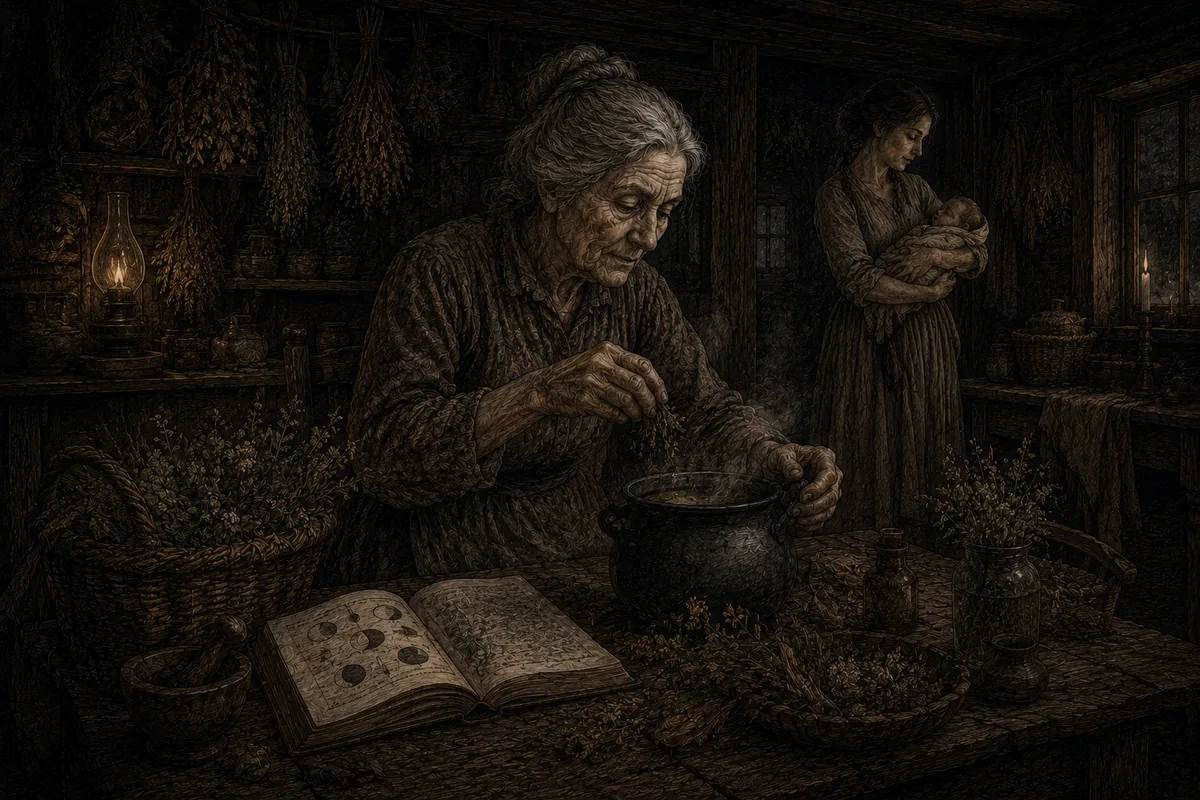
Granny women — not a creature but a real social figure of Appalachia: the elderly woman recognised as an authority in matters of childbirth, herbs and care.
- Variants and names
- granny woman, granny midwife, neighbor lady, yarb doctor (from herb doctor), blood stopper, fire talker, water witch; the term granny witch is a recent label; parallel traditions are the German-area Braucherei or Powwow and African American hoodoo
- What is told
- Not a creature but a real social figure: an elderly woman recognised as an authority in matters of childbirth, miscarriage, infant care, wounds, fevers and snakebite. Her competences included the local plant pharmacopoeia, empirical midwifery, care of the body after death and the reading of lunar signs for sowing and slaughtering. The verbal component, made up of prayers and formulas to stop blood or draw the fire out of burns, was integrated with the pharmacological one and not an alternative to it: in the practitioners' own perception it is «the Lord's work», not witchcraft.
- What it was forthe author’s reading
- The de facto health system in a region of structural poverty, where doctors were far away and had to be paid. The figure carries an axis of autonomous female power within a patriarchal society, and it is for this reason that its elimination was political: the campaign of medical professionalisation and the rhetoric of the midwife menace between the 1910s and the 1940s delegitimised traditional midwives and in many states criminalised them, producing an intergenerational break in the transmission of knowledge.
- Where it is attested
- The Foxfire series from 1972, Rabun Gap-Nacoochee School under the direction of Eliot Wigginton, with Foxfire 2 of 1973 devoted among other things to midwifing and burial customs, and the interviews held in the Foxfire Archive; materials of the Federal Writers' Project and the WPA, 1936-1940; Frank Fry Collection of the Hunter Library, Western Carolina University; communications to the Appalachian Studies Association, including the 2017 paper on the midwife menace; feature by the Smithsonian Center for Folklife and Cultural Heritage, 2025.
- Caution
- The historical phenomenon, that is the social figure, the pharmacopoeia, the midwifery and the verbal healing, is grade A, with solid archival and oral documentation. Grade C, and this is why the entry as a whole is classified C as a precaution, applies instead to the now viral reconstruction of the granny witch as the priestess of a coherent, initiatory, pre-Christian magical system handed down through the female line: that picture is a late twentieth-century and post-Internet construction which flattens Christian, Protestant and pragmatic practices onto a neopagan model alien to the sources.
The grade says how well the entry is documented, not how interesting it is. How the grades are assigned.