Min Min lights
Australia
Channel Country, western Queensland; the road between Boulia and Winton
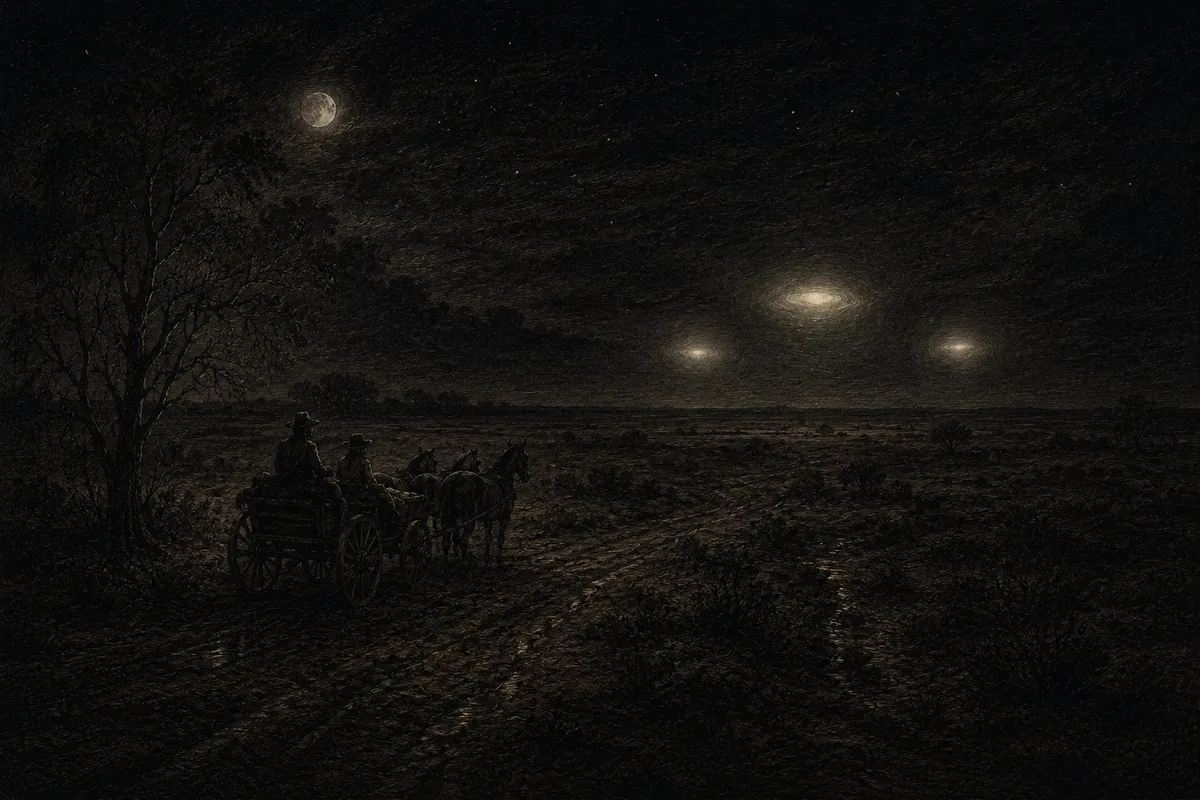
Min Min lights — a nocturnal luminous object, discoid, with blurred and shifting edges, of apparent diameter between a quarter and half the full Moon; white, or else green, yellow, red or blue; suspended a little above the horizon.
- Variants and names
- Min Min light, Min Min lights: a colonial name, from the place name Min Min, a tiny settlement with a staging post on the road between Boulia and Winton. The etymology of the place name is uncertain and must be declared as such: a derivation from an Aboriginal language of the Cloncurry area has been suggested, or else from the name of the hotel, and neither is demonstrated. The languages of the country are Pitta Pitta and, further north, Kalkatungu
- What is told
- A nocturnal luminous object, discoid, with blurred and shifting edges, of apparent diameter between a quarter and half the full Moon; white, or else green, yellow, red or blue; suspended a little above the horizon. It seems to follow the traveller, or to go before him, or to withdraw as one approaches, and it vanishes abruptly. The corpus is made up overwhelmingly of accounts by drovers, drivers and travellers of the Channel Country.
- What it was forthe author’s reading
- In the colonial corpus the narrative function is clear: a marker of the danger of nocturnal space for those travelling alone, and a binding agent of outback identity. From the mid twentieth century an economic and explicit one is added, tourism. On the Aboriginal side I formulate no functional hypotheses: the accessible documentation does not allow it.
- Where it is attested
- The earliest account cited is of 1838, but it is not located in the Boulia area and may concern a different phenomenon. The official local version places the first sighting in the area in the 1890s, by a grave behind the Min Min Hotel — this is local tradition, not a period text. The canonical case of the corpus is the drover's episode of 1918; there follow a much-cited account by Henry Lamond in 1937 and the first systematic collection, Maureen Kozicka, The Mystery of the Min Min Light, 1994. The decisive study is John D. Pettigrew, «The Min Min light and the Fata Morgana. An optical account of a mysterious Australian phenomenon», Clinical and Experimental Optometry 86(2), March 2003.
- Caution
- It is the only entry in this atlas that has an experiment behind it, and that is the reason it is worth reading to the end. Two recurrent formulas need correcting. The first is «inverted mirage»: the phenomenon is a superior mirage, and the inversion is the thermal one, not that of the mirage — the Fata Morgana is already the superior case. The second is «Pettigrew proposed a theory»: that is reductive, because he reproduced the lights. To be rejected, on the other hand, is the objection that the lights predate colonisation and therefore cannot be headlights: it is a non sequitur, because the mechanism works with any light source, campfires included. Secondary sources report, attributing it to Aboriginal people, the observation that sightings are said to have increased with the European entry into the outback and that the older accounts described stationary lights while recent ones describe them moving: this is a claim that circulates almost only at second hand and I report it as such — if, however, the lights are refractions of real sources, the shift from campfires to vehicle headlights would make that distinction physically coherent.
The grade says how well the entry is documented, not how interesting it is. How the grades are assigned.