Saci-Pererê
Brazil
Vale do Paraíba and the Brazilian south-east, with Monteiro Lobato's inquiry centred on Taubaté
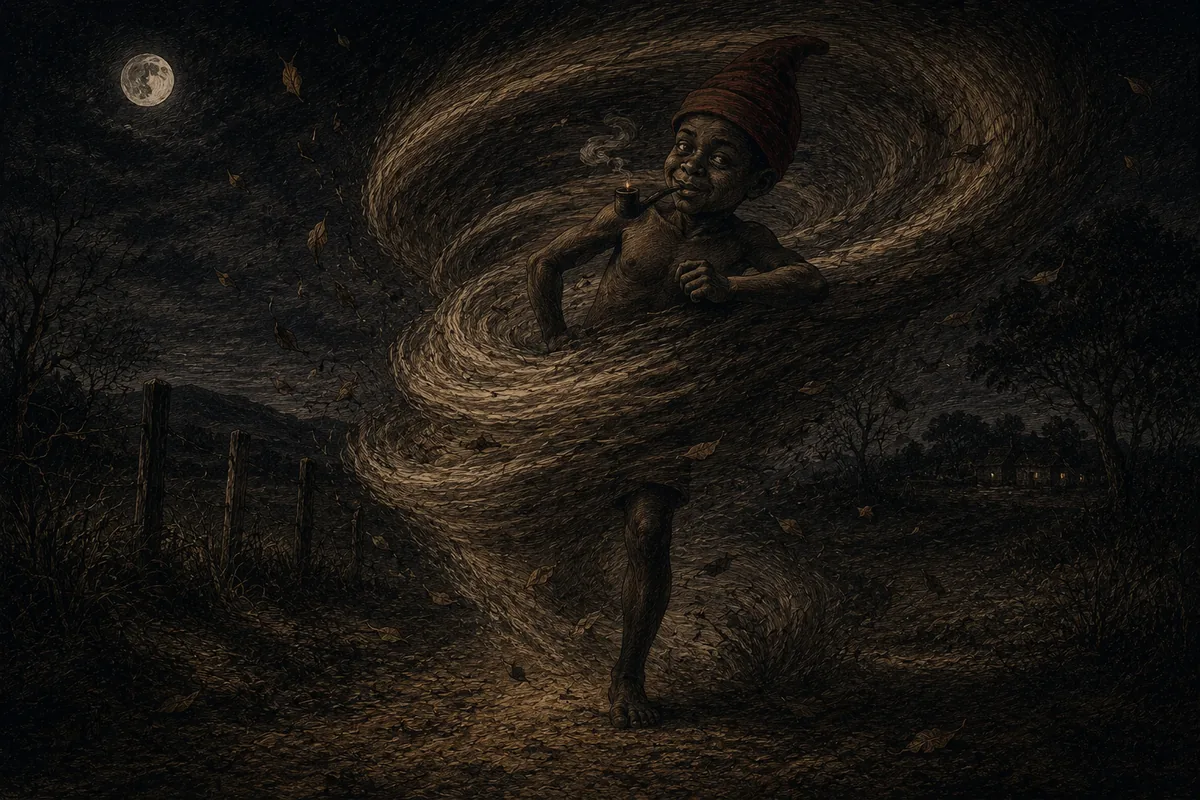
Saci-Pererê — a black boy with a single leg, a red cap and a pipe, who travels inside dust devils and stinks of sulphur.
- Variants and names
- Saci, Saci-pererê, Saci-cererê, Saci-trique (more benign), Saci-saçurá (red-eyed); in the North Matinta Perera, which is however a different figure. Tupi sa'si; pererê from pererek-a «to hop». «Saci» also denotes a real bird, the striped cuckoo Tapera naevia, whose descending nocturnal whistle lies at the origin of the acoustic association
- What is told
- A black boy with a single leg, a red cap and a pipe, who travels inside dust devils and stinks of sulphur. He makes people lose their way, plaits horses' manes, turns milk sour, hides objects. He is caught with a sieve, with a rosary, or by snatching off his cap, and is imprisoned in a bottle stoppered with a cross. The nineteenth-century form is dangerous, not likeable: the tameable, playful Saci is a twentieth-century construction.
- What it was forthe author’s reading
- To explain small domestic and agricultural disorders without having to lay the blame on someone in the house; to give form to nocturnal bewilderment and to the dust devil that crosses the ploughed fields; and to serve as a pedagogical terror for children. Some scholars also read in it an expressive channel for a subaltern black and indigenous imaginary, which is plausible but hard to document.
- Where it is attested
- Cascudo places the first accounts in the nineteenth century; related material in Couto de Magalhães (1876), Sílvio Romero (1885), Barbosa Rodrigues, Poranduba Amazonense (1890). The turning point is Monteiro Lobato, who in 1917 launched in the evening edition of O Estado de S. Paulo the inquiry «Mitologia Brasílica — Inquérito sobre o Saci-Pererê», three questions to readers; out of it came O Sacy-Pererê: resultado de um inquérito, São Paulo 1918, some three hundred pages, which Lobato did not sign as author. In 1921 O Saci brought him inside the Sítio do Picapau Amarelo.
- Caution
- Grade B is for the recording, not for the diffusion: the belief is real and very widespread, but it was recorded late and its canonical form is authorial. Lobato did not invent the traits — he collected them — but he selected one variant among dozens, expunged the competing ones (the white saci, the bird-saci, the female saci), and above all shifted the figure from the register of terror to that of the playmate caught in a bottle. The two mirror-image theses in circulation — «Lobato invented the Saci» and «Lobato merely collected him» — are both wrong. Also to be corrected is the idea that this is African folklore brought by the slaves: the base is composite, with a Guaraní substratum in the Jasy Jaterê, a blond and two-legged sprite. And Saci Day on 31 October is not federal law: it is a law of the State of São Paulo of 2004 and of a dozen municipalities.
The grade says how well the entry is documented, not how interesting it is. How the grades are assigned.