Yowie
Australia
New South Wales: nineteenth-century attestation in the Blue Mountains and on the south coast, modern corpus in south-eastern Queensland
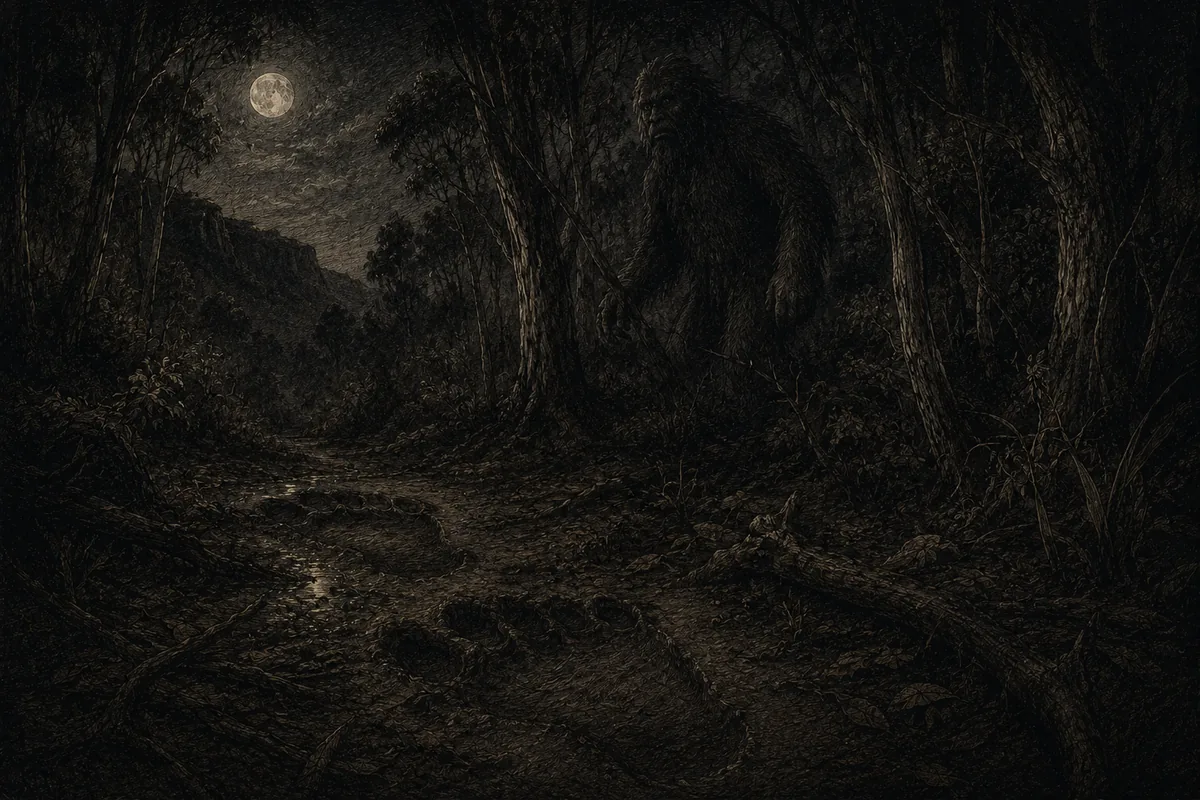
Yowie — in the modern corpus a hairy hominid two metres tall, which leaves enormous footprints in the forests of south-eastern Queensland.
- Variants and names
- Yō-wī, recorded in 1875 among the Gamilaraay by the Reverend William Ridley and glossed — in the missionary's translation — as «a spirit that roams the earth by night». Colonial names: yahoo, the dominant form in the nineteenth century, Yahoo-Devil Devil, hairy man of the wood, indigenous ape, and in the twentieth century Australian Bigfoot
- What is told
- In the modern corpus it is a hairy hominid two metres tall, which leaves enormous footprints in the forests of south-eastern Queensland. In the nineteenth-century corpus — the only one that is really documentable — it is something else. In 1842 the «Yahoo» is described as resembling a man, with long white hair, extraordinarily long arms, great claws and its feet turned backwards. Reversed feet and claws are traits of a spirit being, not of a primate: whoever cites that passage as evidence of a hominid is reading against the text. The first frankly zoological description is of December 1882, and comes from a settler amateur naturalist who was looking for a new species.
- What it was forthe author’s reading
- On the colonial side the interpretation is relatively solid, because the object is settler culture: the nineteenth-century «yahoo» functions as a settler projection onto the bush, at a moment of intense expectation of zoological discoveries in a continent perceived as an open inventory, with the orangutan exhibited in captivity as an available imaginative model. The English name then draws on Swift's Gulliver's Travels, 1726. On the Aboriginal side I formulate no hypotheses: I have no documentation that would allow it.
- Where it is attested
- Swift, 1726, for the English word; Australian and New Zealand Monthly Magazine, 1842, for the description of the «Yahoo»; William Ridley, Kámilarói and Other Australian Languages, second edition, Sydney 1875, for the first attestation of the word in an Aboriginal language; Australian Town and Country Journal, November 1876 and December 1882. On the historiographical side: Graham Joyner, The Hairy Man of South Eastern Australia, 1977; Robert Holden, Bunyips: Australia's Folklore of Fear, 2001. The nineteenth-century corpus is entirely searchable in the Trove digital archive of the National Library of Australia.
- Caution
- The grade is twofold: B for the nineteenth-century stratum, which has an attested core — Ridley's lemma and a corpus of newspaper articles — but is integrally colonial and mediated; C for the corpus after 1975, which is almost solely commercial cryptozoology and tourism. And here the problem is not sensitivity, it is accuracy: «the yowie is a creature of Aboriginal mythology» is a formula to be avoided. What is documented is a Gamilaraay word for a night spirit; the rest is colonial and twentieth-century overlay. The lists of «Aboriginal names for the yowie» that circulate in the cryptozoological literature were compiled by non-Aboriginal enthusiasts, almost always omit the language they belong to — which makes them unverifiable — and merge beings from unrelated cosmologies: the Quinkin of the rock art of Cape York and the Pangkarlangu of the Warlpiri tradition of the central desert are not variants of an Australian Bigfoot. Refusing that list is both more respectful and more exact than reproducing it.
The grade says how well the entry is documented, not how interesting it is. How the grades are assigned.