Brown Mountain Lights
the United States
Burke County, North Carolina, Appalachian Blue Ridge
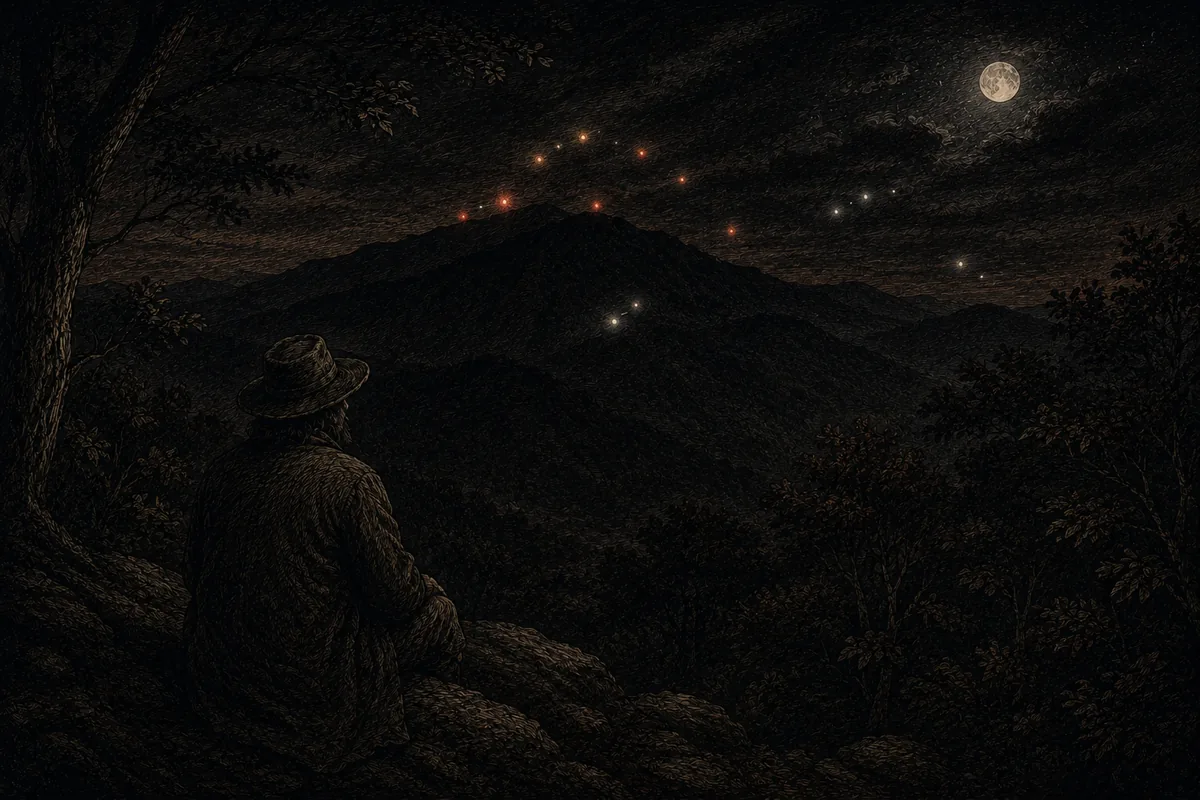
Brown Mountain Lights — point-like reddish, yellowish or white lights that appear on the flank of the mountain, move, divide and go out.
- Variants and names
- Brown Mountain Lights, in the singular the Brown Mountain Light; no dialect variant documented
- What is told
- Point-like reddish, yellowish or white lights that appear on the flank of the mountain, move, divide and go out. There is no creature at all: the tradition is a luminous theophany, and the narrative explanations have been grafted on afterwards, such as the ghosts of a murdered wife or of a slave with a lantern searching for his lost master. The canonical observation points are Wiseman's View, milepost 310 of the Blue Ridge Parkway and the NC-181 near Jonas Ridge.
- What it was forthe author’s reading
- It marks a place as a threshold and organises a precise social practice, the legend trip, that is, the collective night-time outing to the overlook. It further serves as a local identity narrative and, since the Second World War, as an explicit tourist resource.
- Where it is attested
- First attestations in print around 1910, coinciding with the electrification of the valley and with the adoption by the Southern Railway, in 1909, of headlights of 600,000 candlepower. USGS investigation of 1913 by D. B. Sterrett and USGS investigation of 1922 by George R. Mansfield, carried out with a plane table and checked against the train timetables, republished as USGS Circular 646 in 1971: 47 per cent motor-car headlights, 33 per cent locomotive headlights, 10 per cent fixed lights, 10 per cent brush fires. National diffusion through the bluegrass song by Scotty Wiseman, 1961.
- Caution
- The claim that the Cherokee observed the lights from 1200 appears for the first time in an article in the Asheville Citizen of 1938, with no indication of sources, and is considered by scholars of native traditions a myth invented by white authors: it is material of grade C. The supposed sighting by the Wiseman family «around 1854» was likewise published only in 1971 and is not verifiable. The local tradition is genuine but recent, of the early twentieth century, not of the nineteenth.
The grade says how well the entry is documented, not how interesting it is. How the grades are assigned.