Munaciello
Campania · The Mezzogiorno
Naples and the Vesuvian area
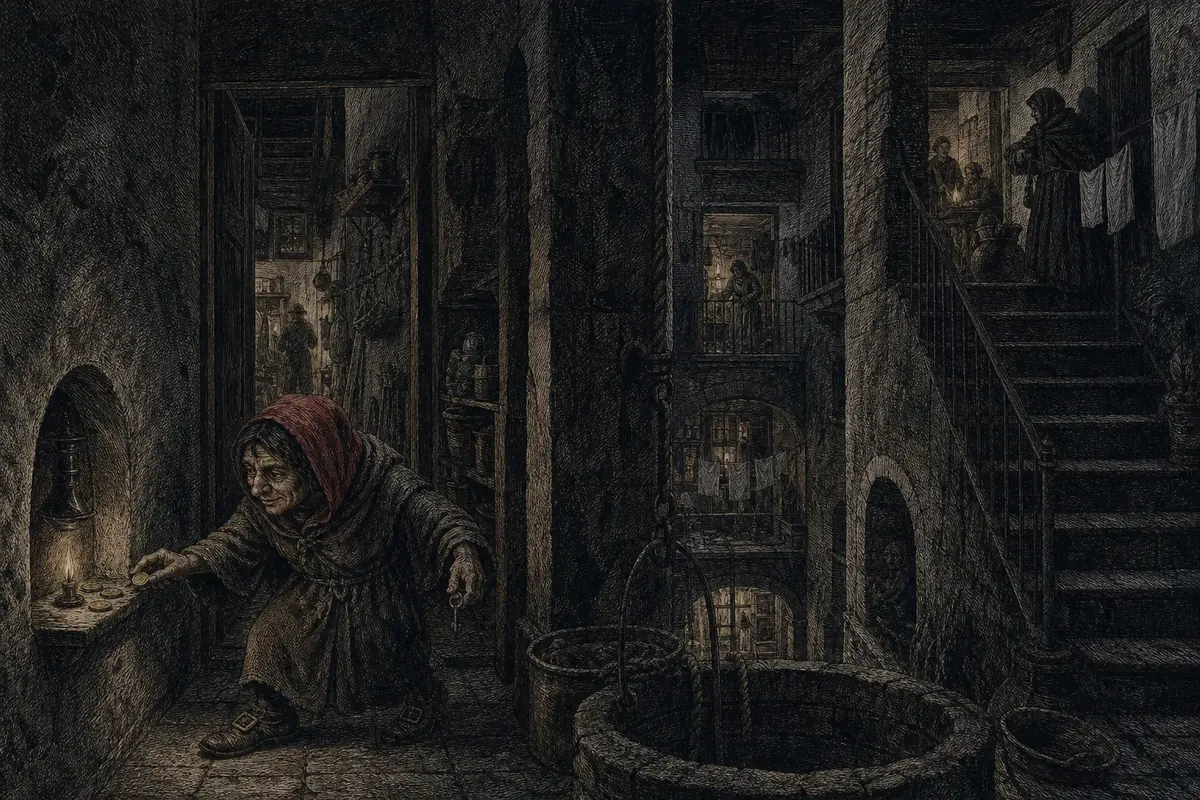
Munaciello — a child or an adult of very short stature, often deformed, in a monk's habit with silver buckles on his shoes.
- Variants and dialect names
- Munaciello, monaciello; in the same family the Salentine Munaceddhu, the Lucanian Munachicchio, the Sicilian Monacello
- What is told
- A child or an adult of very short stature, often deformed, in a monk's habit with silver buckles on his shoes. Benevolent (he leaves money, suggests numbers), mischievous (he hides objects, blows into sleepers' ears), troublesome. Revealing his presence brings misfortune. Red hood, good fortune; black, disaster.
- What it was forthe author’s reading
- A socially acceptable cover for disappearances of money in overcrowded tenement houses, night-time noises in Neapolitan buildings, sudden gains or losses, domestic thefts and small undeclarable earnings.
- Where it is attested
- The most frequently cited provision is traced back to a viceregal prammatica of the count of Miranda of 24 December 1587, under the heading De locato et conducto, which is said to have allowed the tenant to leave without paying a house believed to be infested by Monacelli. Later bibliography: A. M. Ortese, Il Monaciello di Napoli, 2001.
- Caution
- Note: that passage comes from an eighteenth-century commentary — Grimaldi, Istoria delle leggi e magistrati del Regno di Napoli, vol. IX, 1771, p. 4 — and I have not been able to check it against the original normative text. Zingaropoli, Case infestate dagli spiriti, 1917, which is the classic on the subject, does not cite it. It is to be presented as a second-hand erudite report, not as archival evidence. The story of Stefano Mariconda and Caterinella Frezza, set in 1445, is by Matilde Serao, Leggende napoletane, 1881, and has no archival corroboration: Serao is a witness to the folklore of 1881, not to that of the fifteenth century. The pozzari hypothesis is a modern rationalisation.
The grade says how well the entry is documented, not how interesting it is. How the grades are assigned.