La Llorona
Mexico
Mexico City and the central plateau, with diffusion throughout the Spanish-speaking world
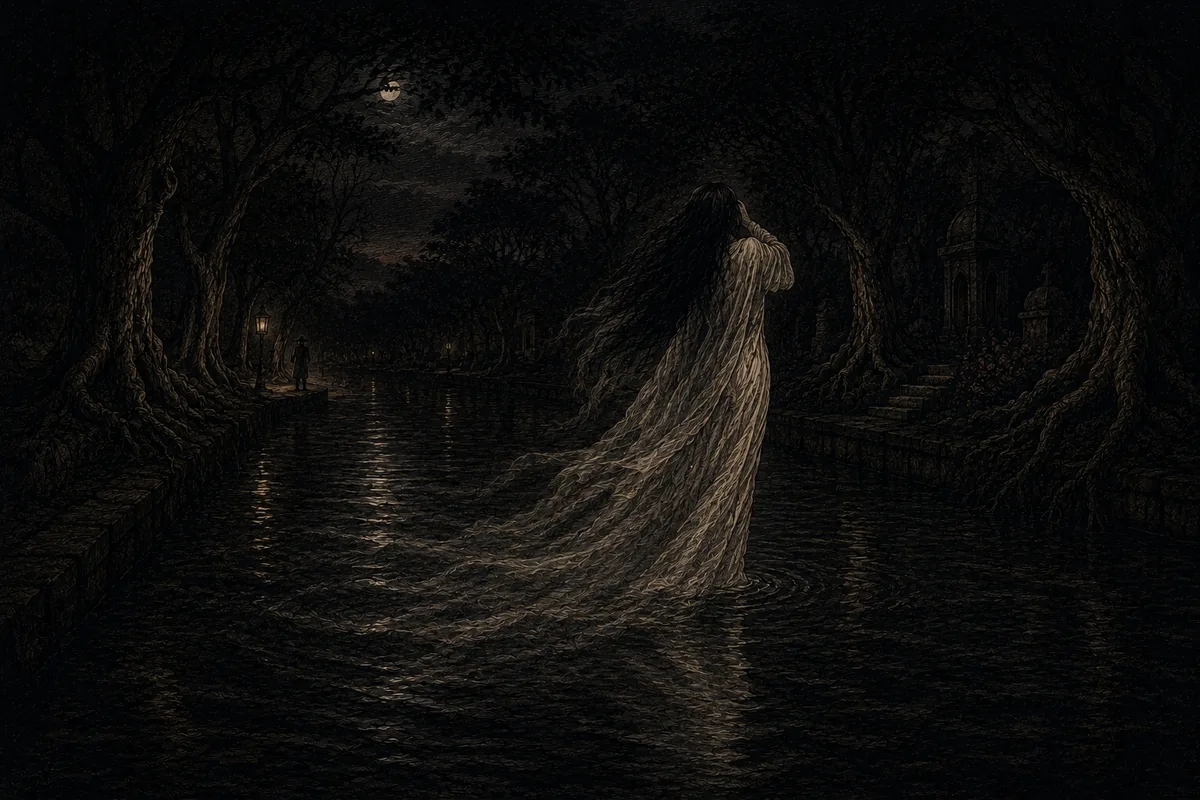
La Llorona — a woman dressed in white who at night, along the canals and the rivers, weeps for her children and calls: «Ay, mis hijos».
- Variants and names
- La Llorona, «the weeping woman». Related figures elsewhere: la Sayona in Venezuela, la Cegua in Central America. The Nahuatl names attributed to her — Cihuacóatl «serpent woman», Tonantzin «our revered mother», Chocacihuatl «woman who weeps» — are retrospective attributions: no colonial source calls a Nahua entity Llorona
- What is told
- A woman dressed in white who at night, along the canals and the rivers, weeps for her children and calls: «Ay, mis hijos». In the form now canonical she drowned them herself, out of jealousy or out of despair, and is condemned to look for them for ever; whoever meets her and answers her dies, or goes mad. In the oldest documented form, however, there is no infanticide: in the sonnet of 1849 she is the ghost of a woman murdered by her husband, who wanders at night wrapped in her mantle.
- What it was forthe author’s reading
- In the current reading she serves to control the night-time movement of women and to keep children away from the water. The Chicana reading of the last half-century — Anzaldúa, Cisneros — turns her round into a figure of mourning and of resistance. Both are interpretations: the first functionalist, the second political, and neither of the two is documented by the sources.
- Where it is attested
- The first literary reference is the sonnet «La Llorona» by Manuel Carpio, 1849; the first extended narrative treatment is José María Marroquí, La Llorona. Cuento histórico mexicano, México, Imprenta de Ignacio Cumplido, 1887; the viceregal setting in Mexico City is canonised by Luis González Obregón, México Viejo, 1900, and Las calles de México, 1922, which however backdates it without citing archival documents. An Iberian analogue earlier than the mature Mexican form is «El Pozo de La Llorona» by José María León y Domínguez, Cádiz 1866.
- Caution
- The B grade is the consequence of one thing only: the record is late and literary, and the colonial anchoring is not there. The crux is the sixth omen of the conquest in book XII of Bernardino de Sahagún's Florentine Codex, which everybody cites as proof of the Aztec origin. The Nahuatl text says only that «many times a woman was heard going about weeping and crying out, at night she cried aloud: my children, now we must go away». It does not name Cihuacóatl and it does not name Tonantzin. That Cihuacóatl cries out at night is written elsewhere, in two other books of the same work. The welding of the two passages, and then of the compound with a nineteenth-century legend, is a modern reader's operation: no colonial source performs it. It should be added that the eight omens are considered by scholars a retrospective post-conquest construction, not prophecies recorded before 1519.
The grade says how well the entry is documented, not how interesting it is. How the grades are assigned.