Il drago della Valnerina
Umbria · Central Apennines and the Adriatic
Castel San Felice, a hamlet of Sant’Anatolia di Narco (province of Perugia); abbey of Santi Felice e Mauro, on the bank of the river Nera
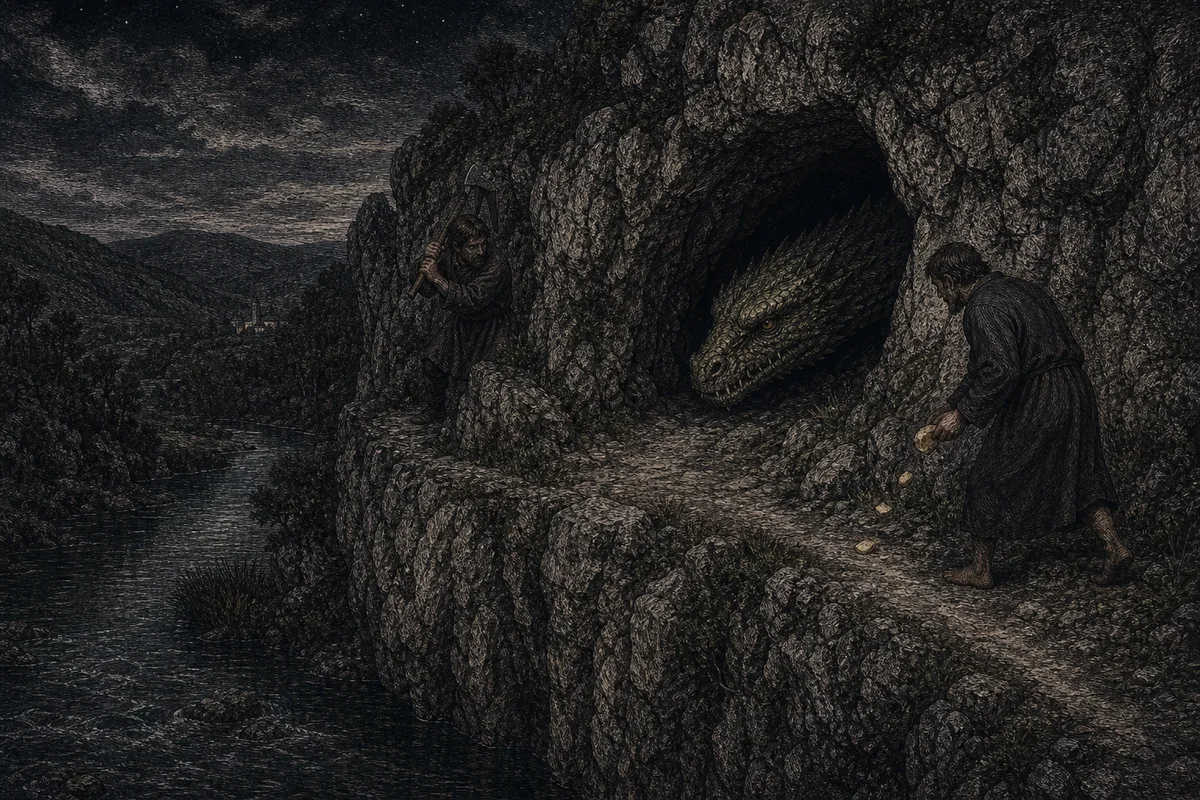
Il drago della Valnerina — a great dragon infests the valley of the Nera, devours men and livestock and poisons the air.
- Variants and dialect names
- pestiferus draco, the pestiferous dragon; in local tradition «the dragon of the valley». The two protagonists are the hermit saints Mauro and Felice, father and son.
- What is told
- A great dragon infests the valley of the Nera, devours men and livestock and poisons the air. Two hermits — Mauro and his son Felice — decide to finish it, and the way they do it is the part that makes the story worth telling: Felice draws the beast out of the cave by dropping little pieces of bread; Mauro waits for it to one side with an axe, and as soon as the dragon puts out its head he strikes it off. The head rolls into the river. On the spot the church later rises.
- What it was forthe author’s reading
- The dragon of the Valnerina is a hydraulic dragon. The valley of the Nera was marshy and malarial, and the work of the monks there was one of reclamation: regulation of the waters, channels, land returned to cultivation. The beast that poisons the air and lairs by the river is the marsh, and to kill it is to drain it. This is not a modern reading imposed on the text: it is the function the episode performs in the foundation story of an abbey that really did that work.
- Where it is attested
- The oldest document is not a text but an object: the relief carved on the Romanesque façade of the abbey, late 12th century, which sets out the episode in four scenes — the dragon's cave, the killing, Felice in prayer, the miracle of the widow's son. The written sources are later and hagiographical: L. Jacobilli, Vite de’ Santi e Beati dell’Umbria, Foligno, 17th century; A. Fabbi, Storia dei Comuni della Valnerina, 20th century. Entries: Umbria Tourism, Abbazia di San Felice e Mauro. Among the texts cited in the local bibliography there also appears the Speculum Cerretanorum of Teseo Pini, 1485.
- Caution
- Who kills the dragon, Mauro or Felice? The written sources do not agree: some versions give the mortal blow to Mauro, others have Felice behead the beast. The relief on the façade, which is four centuries earlier than Jacobilli, shows Mauro. When the written sources quarrel and the stone answers, it is as well to listen to the stone — but the question remains open and this entry leaves it open. I have not consulted Jacobilli directly, nor a Latin Vita of the two saints: the grade stays at B until I have.
The grade says how well the entry is documented, not how interesting it is. How the grades are assigned.