Aluxo'ob
Mexico
Yucatán Peninsula, milpas and Maya ruins; ethnographic documentation centred on Chan Kom
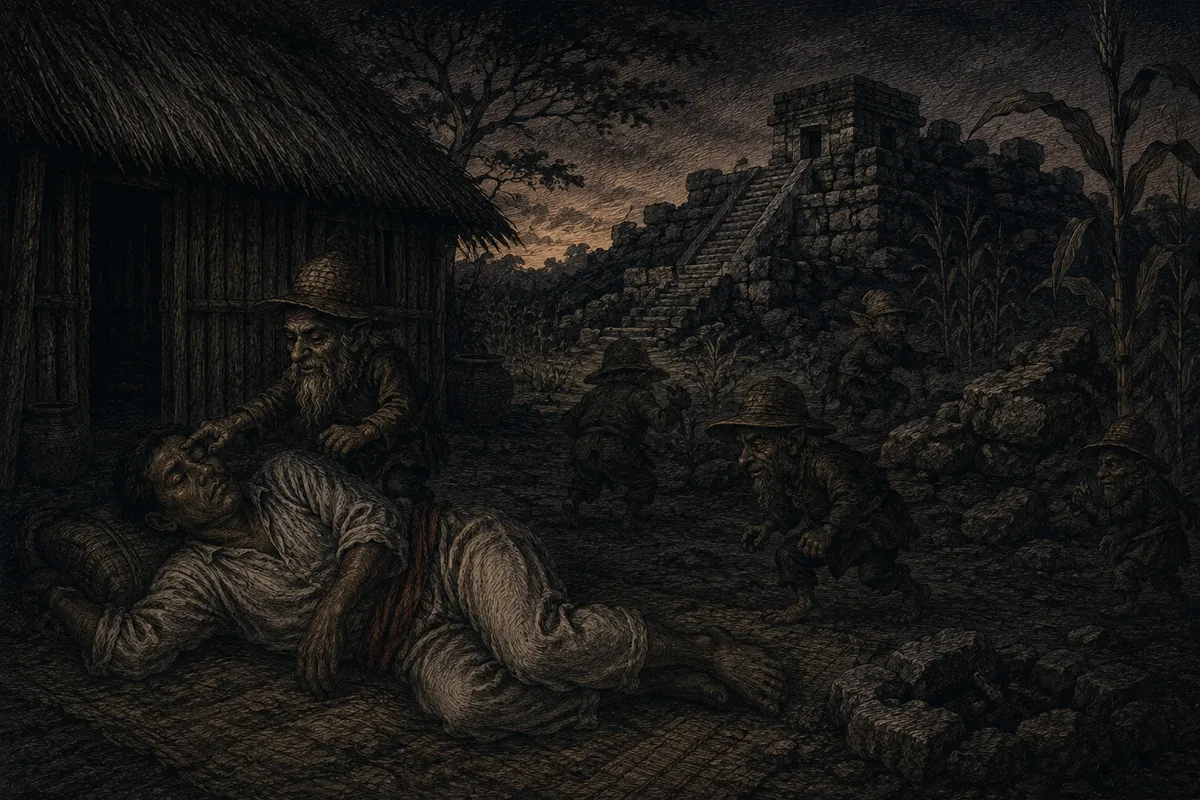
Aluxo'ob — small bearded men with hats, who inhabit a lower world and are neither human nor divine.
- Variants and names
- Yucatec Maya alux, plural aluxo'ob, in Spanish aluxes; variant arux. The literal meaning is not established: the widespread etymology «strong clay images» goes back to Brinton, 1883, and is today considered a folk etymology. Not to be confused with the Nahua chaneque, a distinct tradition
- What is told
- Small bearded men with hats, who inhabit a lower world and are neither human nor divine. They come out at nightfall from the ruins and the heaps of stones, walk about around the houses, guard the milpa and in exchange for offerings protect the maize from predators. In the first documented description, of 1861, the dominant trait is however another: their touch is malign and causes illness, and if they find someone asleep they pass their hand over his face so lightly that the sleeper does not notice — and he takes a fever.
- What it was forthe author’s reading
- They codify the relationship between the farmer and a piece of ground that already belonged to someone else: in Yucatán the milpa is opened inside a forest full of mounds and ruins, and the non-human owners of the place have to be acknowledged and paid. They also formalise the attribution of fevers and accidents to an entity with which one can negotiate.
- Where it is attested
- First solid written attestation: the report of Santiago Méndez on the Maya of Yucatán, 1861, published in English translation in 1921 under the editorship of Marshall H. Saville. Then Daniel G. Brinton, The Folk-Lore of Yucatan, 1883, the first comparative treatment. Systematic ethnographic documentation begins with Robert Redfield and Alfonso Villa Rojas, Chan Kom: A Maya Village, Carnegie Institution of Washington, 1934, who also reproduce drawings of the aluxes made by the inhabitants; then Villa Rojas, The Maya of East Central Quintana Roo, 1945, and Bruce Love, Maya Shamanism Today, with direct documentation of agricultural ceremonies at Becanchén in 1978 and at Cobá in 1983.
- Caution
- One point has to be declared, because it is the place where the entry is weaker than it is made to appear: the colonial attestations are missing. The term alux does not appear in Landa and has no secure attestation in the great Yucatec colonial vocabularies. Those who cite «colonial sources» are as a rule in fact citing pre-Hispanic iconography of dwarfs — the Jaina figurines, the court dwarfs on the stelae — which demonstrates an ancient interest in dwarfs, not the alux belief. The link with the ceramic figurines is ethnographically real but must be stated with precision: elderly milperos describe aluxes as clay idols activated by a ritual specialist, and some identify as such ancient figurines found in the fields. There is however no proof that the pre-Hispanic figurines were aluxes: it is an identification made today on ancient objects. Grade A therefore holds for the ethnographic documentation; for colonial attestation it would be B.
The grade says how well the entry is documented, not how interesting it is. How the grades are assigned.