Haint e haint blue
the United States
Southern Appalachia and the Gullah Geechee Lowcountry (South Carolina and Georgia)
Haint e haint blue — the haint is not the personal ghost of high Anglo-Saxon tradition, but a restless dead person or a generic malevolent spirit, often tied to a place: a ford, a crossroads, a house, a tree.
- Variants and names
- haint, hant (dialect spelling of haunt); booger, boogerman in Appalachia; the apotropaic colour known as haint blue, from indigo
- What is told
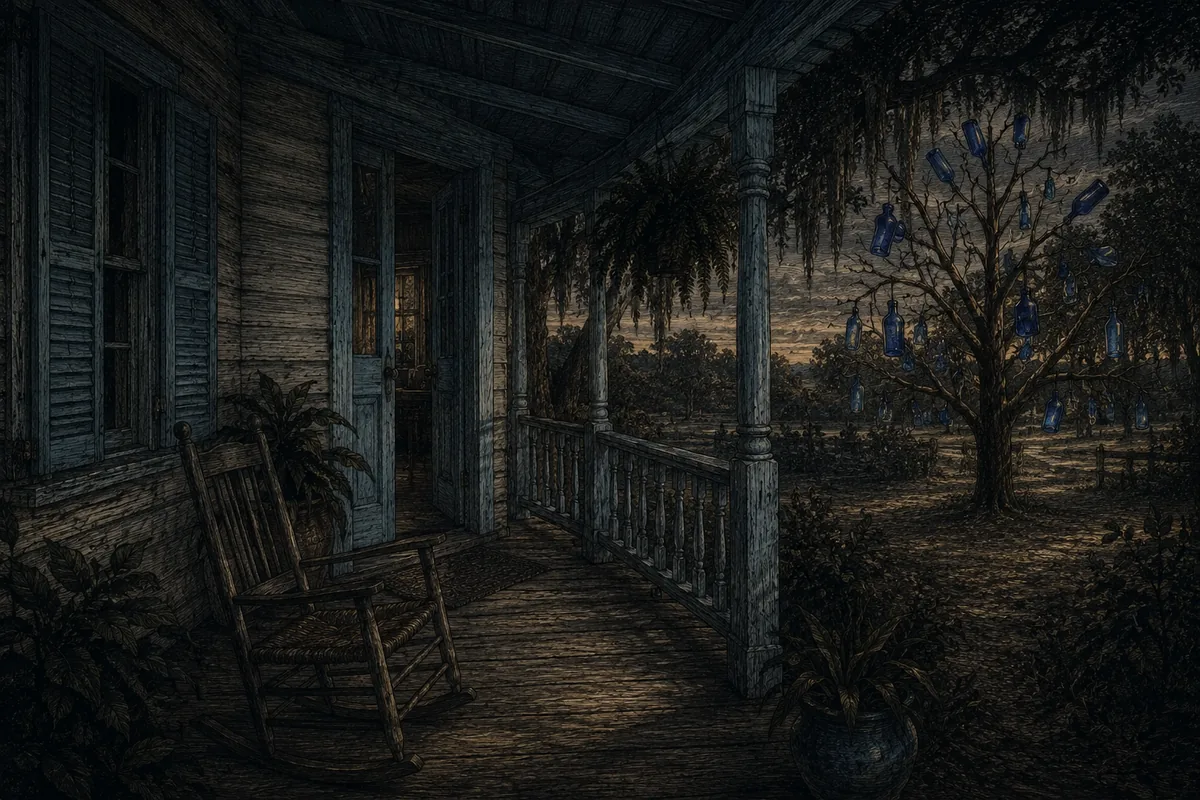
- The haint is not the personal ghost of high Anglo-Saxon tradition, but a restless dead person or a generic malevolent spirit, often tied to a place: a ford, a crossroads, a house, a tree. The operative premise of the haint blue practice is that spirits cannot cross water, and so porch ceilings, doorframes, window frames and shutters are painted a light blue that imitates water or sky. An associated practice is the bottle tree, blue glass bottles hung from the branches to trap the entities.
- What it was forthe author’s reading
- Codified and very low-cost domestic defence in communities without institutional protection, with symbolic marking of the thresholds of the house. In the Lowcountry it materially binds the dwelling to the inherited African cosmology; in Appalachia the tales of haints and boogers work as a moral map of the night-time territory.
- Where it is attested
- Drums and Shadows: Survival Studies among the Georgia Coastal Negroes, Savannah Unit of the Georgia Writers' Project (WPA), University of Georgia Press, 1940; Jacob Stroyer, Sketches of My Life in the South, 1879; the Foxfire series from 1972 and the volume Boogers, Witches, and Haints. Material evidence in the blue ceilings of the enslaved people's quarters of the Owens-Thomas House in Savannah, early nineteenth century. Institutional recognition: the Gullah Geechee Cultural Heritage Corridor, established by Congress on 12 October 2006 and managed by the National Park Service.
- Caution
- The explanation dominant today, namely that spirits do not cross water, is the current rationalisation, but the WPA sources record a wider and less coherent range of motivations: it should be given as a reading, not as the reading. Grade C applies to the very widespread online claim that haint blue also keeps insects and wasps away. A further distinction must be drawn between the haint blue practice, which is Lowcountry and Gullah Geechee, and the term haint, which is shared across the whole South: confusing the two is the most recurrent error in popular accounts.
The grade says how well the entry is documented, not how interesting it is. How the grades are assigned.