Bell Witch
the United States
Adams, Robertson County, Tennessee, Red River valley (Upland South)
Bell Witch — not a creature but a talking poltergeist, active in Tennessee between 1817 and 1821.
- Variants and names
- The Bell Witch; the entity calls itself «Kate», hence Old Kate Batts' witch; derived place name Bell Witch Cave
- What is told
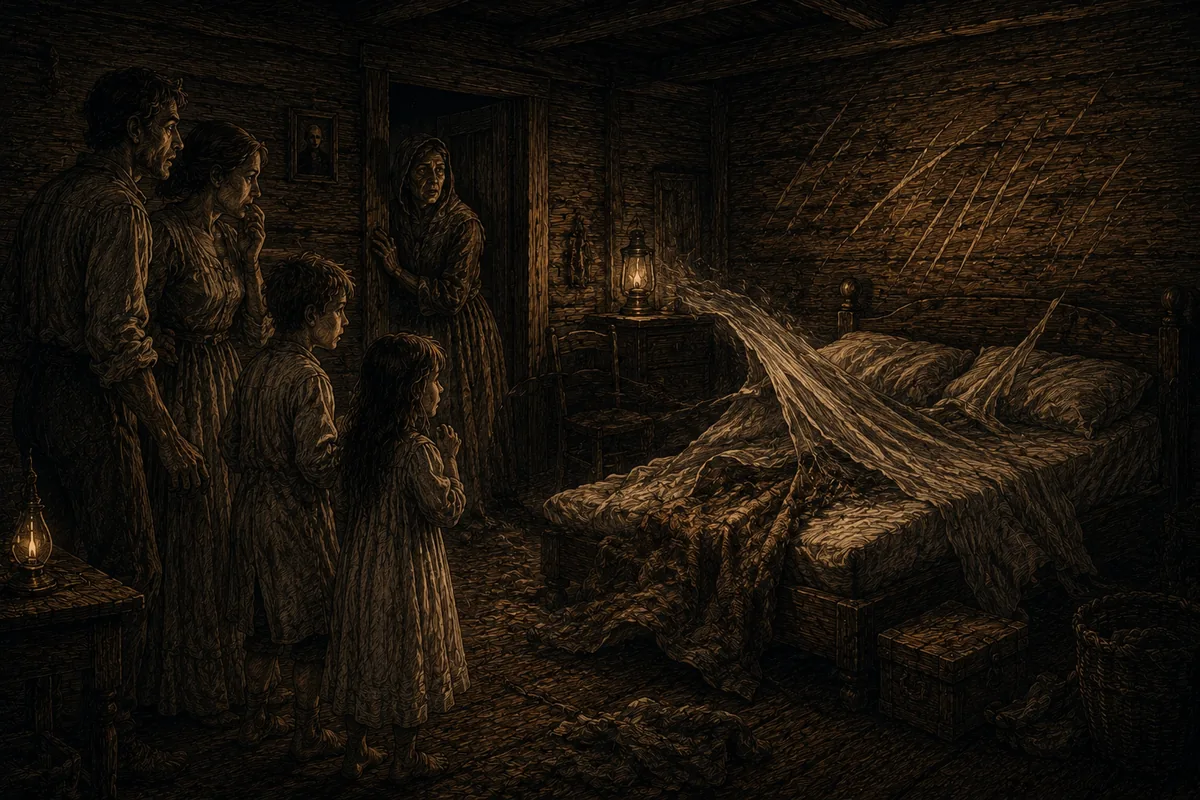
- Not a creature but a talking poltergeist, active between 1817 and 1821. The phenomenology reported includes knocks and scratches on the walls, bedclothes pulled off and above all a disembodied voice capable of conversing, quoting Scripture and repeating word for word sermons delivered at the same moment in different churches. The persecution is directed at John Bell, who died in 1820, and at his daughter Betsy, tormented until she broke off her engagement to Joshua Gardner.
- What it was forthe author’s reading
- A community legend that condenses conflict over land and usurious loans, the tension over the control of daughters' sexuality and marriage and the religious anxiety of the Second Great Awakening in a frontier society. The historian Amy Fluker claims its value as collective memory: it matters little whether the phenomenon was real, what matters is that it was believed in.
- Where it is attested
- First attestation in print in an article in the Saturday Evening Post, January 1856, which attributed everything to Betsy Bell's ventriloquism; Goodspeed's History of Tennessee, 1886; Martin Van Buren Ingram, An Authenticated History of the Famous Bell Witch, 1894. The Tennessee State Library and Archives houses the affair in the exhibition «Tennessee Myths and Legends», thus explicitly classifying it as a legend.
- Caution
- The whole apparatus of narrative detail depends on a single source of 1894, unverifiable and suspected of fabrication: Ingram states that he is reproducing a manuscript of about ninety pages by Richard Williams Bell, which has never been produced and whose author was between six and ten years old at the time of the events. Brian Dunning observes that every direct witness was already dead when Ingram began to write; Joe Nickell identifies anachronisms and Masonic themes; Benjamin Radford notes that the celebrated visit of Andrew Jackson has no documentation whatever. No element of the affair reaches grade A.
The grade says how well the entry is documented, not how interesting it is. How the grades are assigned.