Kitsune
Japan
The whole of Japan; cult centre Fushimi Inari Taisha at Kyoto, poles of possession at Izumo and Shimane
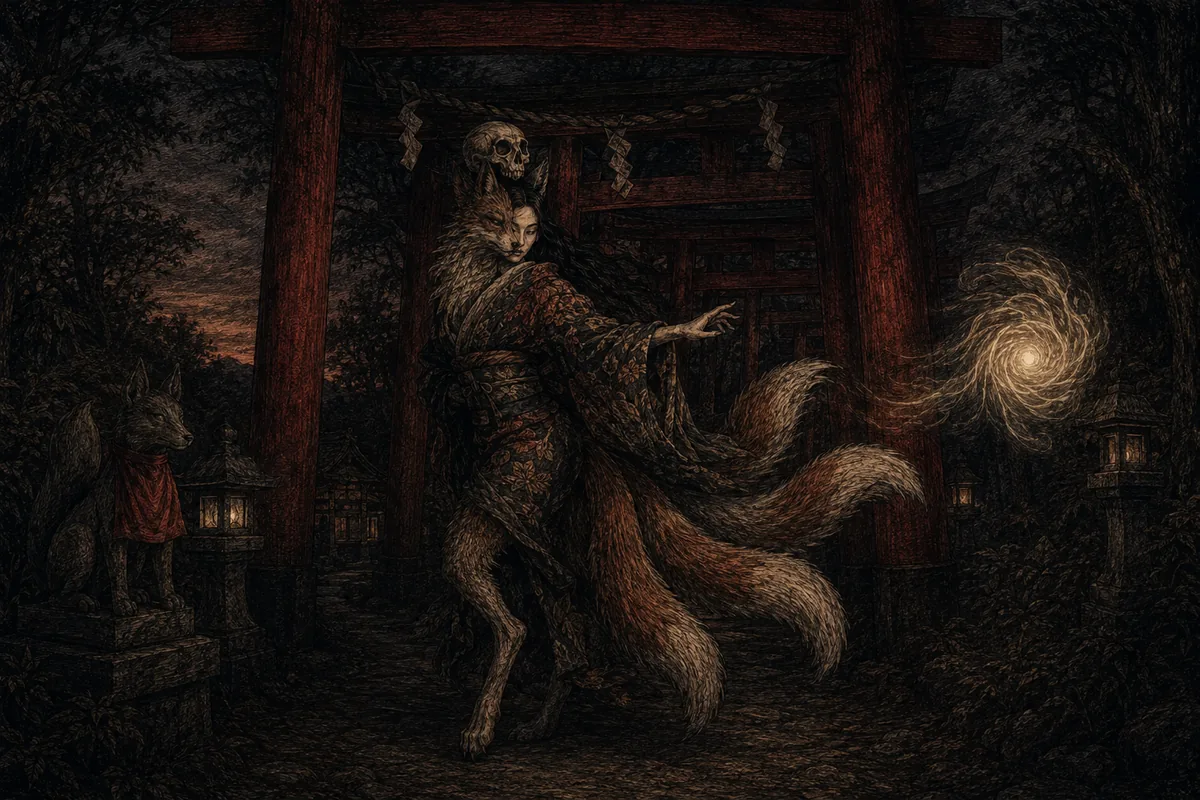
Kitsune — a fox that acquires power with age: at a hundred years it can transform itself and bewitch, and the number of tails grows with age and power up to nine.
- Variants and names
- kitsune; the categories zenko against yako or nogitsune, byakko, tenko; regional osaki in northern Kantō, kuda-gitsune in Chūbu, ninko at Izumo; connected phenomena kitsunetsuki, kitsune-bi, kitsune no yomeiri, kitsune-mochi
- What is told
- A fox that acquires power with age: at a hundred years it can transform itself and bewitch, and the number of tails grows with age and power up to nine. It transforms itself by placing on its head a leaf, a skull or a human hair and performing a ritual turn, and takes the form of a most beautiful woman, of a young girl or of an old man; it possesses the hoshi no tama, the luminous sphere in which its power resides. In the trickster register it makes travellers lose their way and pays with leaves that turn out to be leaves once one is home, with a fine and important moral distinction: the fox's gifts, that is protection, knowledge and longevity, are real, whereas its payments are illusory. The cycle of the fox wives includes Kuzunoha, mother of Abe no Seimei, and Tamamo-no-Mae, the nine-tailed fox.
- What it was forthe author’s reading
- On the religious plane the fox is the messenger of Inari Ōkami, divinity of rice, of agriculture and later of business, with an agronomically motivated link, because foxes prey on the rodents that threaten the rice. Kitsunetsuki is attested as a recognised medical category as early as the Heian period and is the cultural idiom through which psychic and dissociative disorders were expressed, treated by miko and itako by means of kuchiyose. The kitsune-mochi families, above all at Izumo and Shimane, were held to be keepers of foxes that brought them stolen wealth, with a prohibition on marriage and a hereditary stigma: it is a genuine structure of social discrimination, not a picturesque detail.
- Where it is attested
- The word is attested in 794 in the Shin'yaku Kegonkyō Ongi Shiki; the Nihon Ryōiki, about 822, contains the oldest tale of the fox wife and the folk etymology «come and sleep». Konjaku Monogatarishū, 12th century; Ōe no Masafusa, Kobiki, died 1111. Lafcadio Hearn, Glimpses of Unfamiliar Japan, 1894, on the kitsune-mochi of Izumo; Karen A. Smyers, The Fox and the Jewel, University of Hawai'i Press, 1999; Komatsu Kazuhiko; Michael Dylan Foster, 2015. Living rites: Hatsuuma, the first day of the Horse of the second month, today in February, principal festival of Inari; Toyokawa Inari and Yūtoku Inari as centres of pilgrimage.
- Caution
- The link with China is documented and must be stated: the húli jīng and the nine-tailed fox are direct sources, the Renshi zhuan of about 800 is the model of the fox-wife type and the skull method derives from the Youyang zazu of the 9th century. The distinction zenko against yako emerges in the Edo period and was probably imposed by the educated classes; it does not reflect older folkloric beliefs. The etymology of the word remains uncertain and none of the proposals has consensus; that of the Nihon Ryōiki is a narrative folk etymology, not a philological one. The Ōji Kitsune no Gyōretsu procession of 31 December at Tokyo was re-established in 1993 and is therefore a rite of grade B, however ancient its narrative basis.
The grade says how well the entry is documented, not how interesting it is. How the grades are assigned.