ʿIfrīt
Egypt
Urban and rural Egypt; ethnographic documentation collected in Cairo in the 1830s
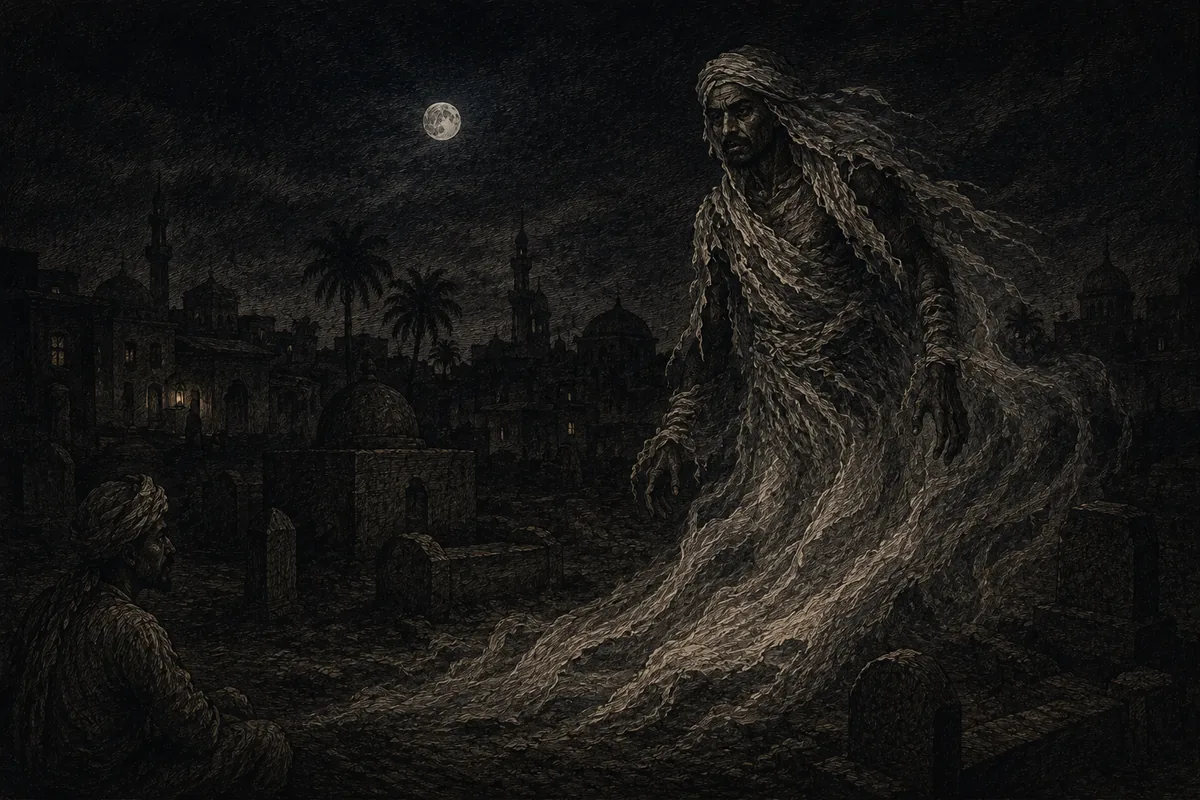
ʿIfrīt — in modern Egyptian usage the ghost, the spirit of a dead person — and the dangerous one is the spirit of a person who has been killed.
- Variants and names
- Classical Arabic ʿifrīt (عِفْرِيت), plural ʿafārīt, feminine ʿifrīta; current Egyptian Arabic ʿafrīt. Nineteenth-century transliterations 'efreet, afreet. The Arabic root means «to roll in the dust», with the value of cunning and strong
- What is told
- In modern Egyptian usage the ʿafrīt is the ghost, the spirit of a dead person — and the dangerous one is the spirit of a person who has been killed. Whoever dies a natural death does not generate an active one; the ʿifrīt forms on the victim's blood, remains bound to the place of the crime, frightens, kills, seeks revenge on the murderer. The attested remedy is to drive a new nail, never used before, into the bloodstain: in this way the ʿifrīt does not form. Martyrs, saints and prophets leave none.
- What it was forthe author’s reading
- The device binds violent death to a place and to an obligation to act: it physically marks the scene of the crime, imposes a precaution visible to all and creates social pressure on the murderer, in contexts where homicide is often a matter of family feud. The iron nail then belongs to a wider logic: iron against the jinn recurs throughout the Islamic Mediterranean.
- Where it is attested
- The Qur'anic occurrence is at 27:39 (an-Naml): before Solomon «an ʿifrīt among the jinn» offers to bring him the throne of the Queen of Sheba before he rises from his place, and is outdone by one who «had knowledge of the Scripture». It is the only occurrence of the root in the whole Qur'an: the word is a hapax, and functions there as an epithet of power, not as the name of a species. The first systematic ethnographic account of jinn and ʿafārīt in Ottoman Egypt is Edward William Lane, An Account of the Manners and Customs of the Modern Egyptians, London 1836, from the surveys made in Cairo in 1833-35; the taxonomy of the jinn in five ascending classes — jānn, jinn, shayāṭīn, ʿafārīt, mārid — is in Lane, Arabian Society in the Middle Ages, posthumous 1883. For the rite of the nail the documentation is twentieth-century: el-Aswad 2002, Lebling 2010.
- Caution
- The two things that circulate most about this entry are both wrong, and the second is instructive. The first: the ʿifrīt is not «the jinn of fire», because all the jinn are of smokeless fire, and it is not the highest rank, because in Lane's list above him stands the mārid. The second concerns the genie of the lamp. Aladdin does not belong to the Arabic manuscripts of the Thousand and One Nights: Antoine Galland heard it told by Ḥannā Diyāb in Paris on 25 March 1709 and published it in the volumes of 1710; the «Arabic manuscripts» of the tale are later back-translations. And English genie comes from the Latin genius by way of the French génie: the resemblance to jinn is a phonetic coincidence exploited by a translator. The whole world iconography of the ʿifrīt rests on a lexical misunderstanding of eighteenth-century France.
The grade says how well the entry is documented, not how interesting it is. How the grades are assigned.