La spada di San Galgano
Tuscany · The Po plain and the northern Apennines
Montesiepi and the abbey of San Galgano, comune of Chiusdino (province of Siena), Val di Merse
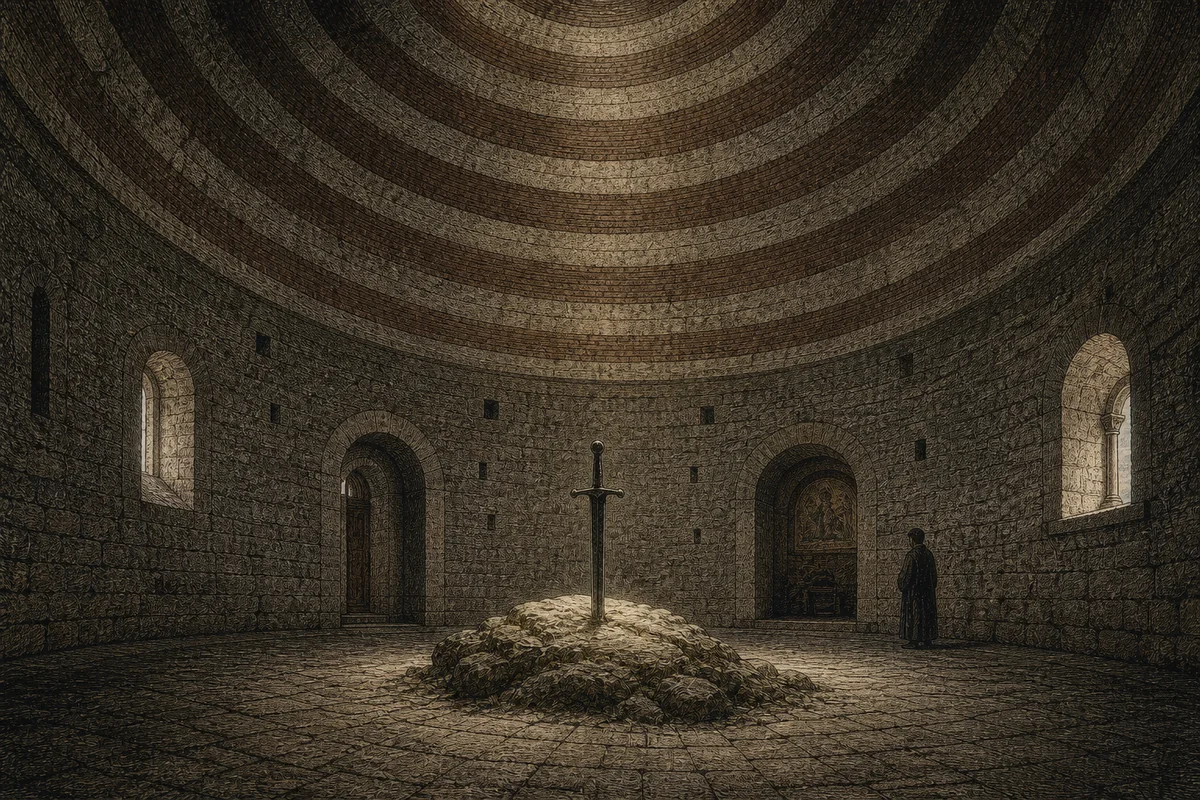
La spada di San Galgano — a knight of the Val di Merse, born around the middle of the 12th century, is converted and withdraws to live as a hermit on a hill above Chiusdino.
- Variants and dialect names
- Galgano Guidotti — but the surname appears only in sources later than the 14th century; in the records of 1185 he is simply Galganus. The place: Montesiepi, the hermitage on the hill, and the abbazia di San Galgano, the Cistercian ruin on the plain.
- What is told
- A knight of the Val di Merse, born around the middle of the 12th century, is converted and withdraws to live as a hermit on a hill above Chiusdino. In December 1180, according to the story, he plants his own sword before him in the form of a cross, and makes it his altar. He dies the following year, on 30 November 1181. In August 1185, a few metres from his hut, three papal delegates collect twenty depositions — among them that of his mother Dionisia — and from that inquiry his cult is born. On the hill the Rotonda rises; on the plain, thirty years later, the great Cistercian abbey. The sword, broken and cemented in place, is still there under a case.
- What it was forthe author’s reading
- Galgano's gesture is not what everyone believes, and it is more interesting. He does not draw a sword to prove that he is king: he drives one in so as to stop being a knight. It is an act of renunciation — the weapon becomes a cross, the tool of the trade becomes an altar — at a moment, the end of the 12th century, when the Church is trying to discipline the violence of the milites. Its later fortune has reversed the sense: from renunciation to investiture.
- Where it is attested
- Standard academic source: Roberta Mucciarelli, entry Galgano, santo, in Dizionario Biografico degli Italiani, vol. 51, 1998. The records of the inquisitio of August 1185, transcribed by Sigismondo Tizio, were edited by Fedor Schneider and studied by Eugenio Susi, L’eremita cortese, CISAM, 1993. On the Rotonda and the frescoes: Roberto Bartalini, Ambrogio Lorenzetti a Montesiepi, in «Prospettiva» 157-158, 2015, which dates the cycle to 1334-1336 and identifies the patron. On the order of the Williamites and the seventeenth- and eighteenth-century hagiographical constructions: Andrea Conti, in San Guglielmo di Malavalle e l’ordine dei Guglielmiti in Toscana, 2020. On the analyses of 2001: articles by CICAP and L. Garlaschelli – M. Calì, La spada nella roccia, 2019. On the Arthurian motif: Francesco Marzella, Excalibur. La spada nella roccia fra mito e storia, Salerno Editrice, 2022, preface by Franco Cardini.
- Caution
- In the primary sources the sword is planted in the earth, not in the rock. The inquisitio of 1185 and the earliest biographies say in terram; the «rock» is a later elaboration. It is the correction that holds up everything else, because it is precisely the stone that acts as the bridge to the Arthurian legend — and that bridge is not there. — The analyses of 2001 did not date the sword. The campaign coordinated by Luigi Garlaschelli (University of Pavia, CICAP) established two things: that no modern alloys were used, so it is not a twentieth-century fake, and that the blade is typologically consistent with swords of type Xa in the Oakeshott classification, that is of the late 12th century. These are conclusions of compatibility, not of dating: iron cannot be dated in absolute terms, and no analysis can establish that that sword was Galgano's. It should be added that there is no peer-reviewed scientific publication of that campaign: the results circulate through popularising articles and a self-published volume of 2019. — The ground-penetrating radar did not find a tomb under the stone. It detected a rectangular anomaly of about two metres by one, at two and a half metres' depth, on the north side of the Rotonda. It has never been excavated. — Finally: the sword has not been intact for eight centuries. Until the 1920s it could be pulled out; it was then fixed with molten lead, cemented, later damaged and broken, and finally covered with a Perspex dome.
The grade says how well the entry is documented, not how interesting it is. How the grades are assigned.