Philadelphia Experiment
the United States
Philadelphia Navy Yard, League Island (lower Delaware valley), with the far end at Norfolk in Virginia
Philadelphia Experiment — the legend that in October 1943 the United States Navy made a ship invisible at the Philadelphia yard.
- Variants and names
- Philadelphia Experiment; in the later tradition «Project Rainbow», a name that appears in no document of 1943 and which arises in 1979 from the vague recollection of an anonymous witness
- What is told
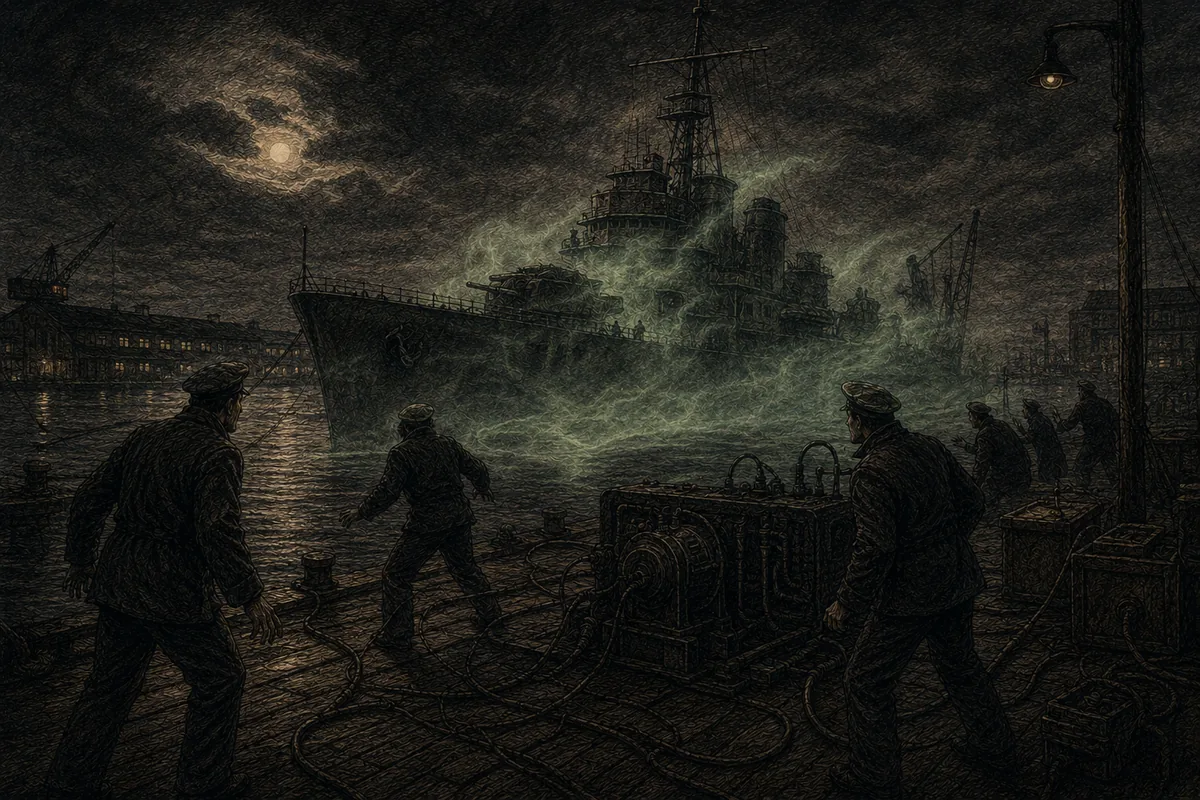
- In October 1943, at the Philadelphia navy yard, the United States Navy is said to have made a warship and its crew invisible. The ship is then said to have vanished from its mooring to reappear a few minutes later at Norfolk, in Virginia, and to have come back. In the canonical form the vessel is the USS Eldridge (DE-173); the sailors come out of the experiment dead, insane, subject to sudden disappearances, or fused into the bulkheads. The precise date and time — 28 October, 17:15 — appear only in the late tradition: the original source writes only «Oct. 1943».
- What it was forthe author’s reading
- It is the best documented case there is of a legend with a single origin: the name of its inventor is known, the dates of his letters, his signed retraction and even the moment at which the story changes shape. It serves to show how a rumour becomes fact without anyone lying openly, and it displays the mechanism by which fiction feeds back into tradition: in the 1990s a witness would declare that he had recovered his own memories of the experiment by watching on television the film that had been made from it.
- Where it is attested
- Two letters from «Carlos Miguel Allende» to the astronomer Morris K. Jessup, dated 13 January and 25 May 1956, reproduced in the so-called Varo edition printed at Garland, Texas, on the initiative of two officers of the Office of Naval Research; public circulation of the letters through Riley Crabb in 1962; Vincent H. Gaddis, Invisible Horizons, 1965; Charles Berlitz and William L. Moore, The Philadelphia Experiment: Project Invisibility, 1979, which fixes the canonical form; film by Stewart Raffill, 1984. On the critical side: Robert A. Goerman, Alias Carlos Allende, Fate, October 1980; Jacques Vallée, Anatomy of a Hoax, Journal of Scientific Exploration, 8(1), 1994; Larry Kusche, review in Skeptical Inquirer, 4(1), 1979. Allende's papers are at the American Heritage Center of the University of Wyoming.
- Caution
- Grade B, and not L, has a precise reason: unlike an authored tale, this story circulated as a belief, not as fiction, and it is exhaustively documented as a legend. Its inventor has a name — Carl Meredith Allen, a merchant seaman from Springdale, Pennsylvania, identified in 1980 by Robert Goerman because he was the son of an acquaintance of his — and in June 1969 he signed, at APRO in Tucson, a retraction in which he declared his own annotations false and admitted that he had written them all himself, in three different hands. But the confession has to be weighed: he retracted it several times, and in December 1979 he wrote to his parents that the real ship was not the Eldridge but the «DE-168». Whether he was a lucid hoaxer or a man with a thought disorder is not established, and the difference is not a small one. To be corrected, because they circulate everywhere: Jessup did not hold a doctorate (he broke off his thesis in 1931, but he was a real astronomer, at the Lamont-Hussey Observatory and then at Drake University); the Eldridge was launched on 25 July 1943 and commissioned on 27 August, not on the 25th; the newspaper article to which Allende refers has never been found by anyone in over sixty years.
The grade says how well the entry is documented, not how interesting it is. How the grades are assigned.