Amabie
Japan
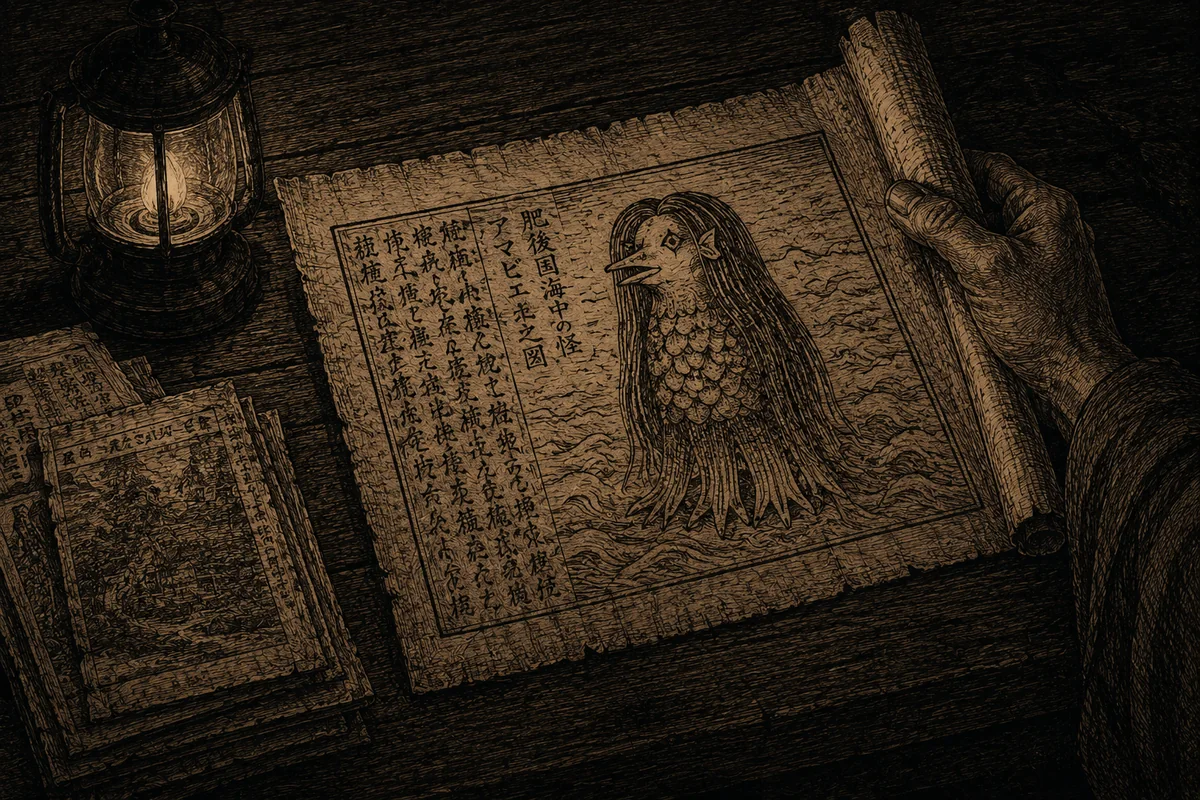
Province of Higo, today Kumamoto prefecture: the document says only «in the sea». The point is conventional; the only material object in existence is the sheet held at Kyoto
Amabie — a sea creature with long hair, a beak, a scaly body from the neck down and three legs.
- Variants and names
- アマビヱ in the original document, with the archaic e ヱ; today アマビエ. The family to which it belongs: アマビコ amabiko, 天彦, 尼彦, 海彦 umihiko, 天日子尊
- What is told
- A sea creature with long hair, a beak, a scaly body from the neck down and three legs. It emerges from the sea radiating light every night; an official of the place goes to see; the creature introduces itself, prophesies six years of abundant harvests and together with them an epidemic, orders that its image be drawn and shown to the people, and returns into the sea. This is all that is known, and it comes from a single sheet. The text says: «I am she who dwells in the sea and is called Amabiye. From this year, for six years, the provinces will have abundant harvests; but together with this, disease will spread. Quickly, draw my figure and show it to the people».
- What it was forthe author’s reading
- A printed talisman sold in a publishing market that already had its genres: the «prophetic beasts» of the late Edo period, from the ningyo of 1805 to the jinja-hime of 1819 to the kudan. The prophecy was the merchandise, and the order to reproduce the image was, literally, the instruction to purchase.
- Where it is attested
- Single source: Higo no kuni kaichū no kai, woodblock print on a single sheet, the middle of the fourth month of Kōka 3, that is the beginning of May 1846, Kyoto University Library, «Shinbun bunko · e» collection, item RB00000122, digitised and freely consultable. Reproduced in Yumoto Kōichi (ed.), Meiji yōkai shinbun, Kashiwa Shobō, 1999. Decisive study: Nagano Eishun, Yogenjū amabiko kō, «Jakuetsu kyōdo kenkyū», 49-2, 2005. Klara Hrvatin, «Japanese Artists' Responses to COVID-19», Asian Studies, 10:1, 2022.
- Caution
- It is not an ancient Japanese protective spirit. It is a sheet of paper, of 1846, and then silence: no shrine, no matsuri, no historical iconographic variant, no oral tradition, no mention in any other source for a hundred and seventy-four years, until March 2020. And probably the name is wrong: Nagano Eishun maintains that アマビヱ is a misprint for アマビコ amabiko — in the incised script コ and ヱ are confused by a single stroke — and the evidence is strong, because the amabiko is attested in more than ten documents against one, is two years older (Echizen, 1844) and has exactly the same pattern. It is therefore the error, not the original, that has reached worldwide fame. Nagano is blunt about the genre: «the amabie is a yōkai invented by the sellers of kawaraban in order to sell kawaraban». The viral version of 2020, finally, has amputated the text: it keeps the epidemic and throws away the six years of abundant harvests, which on the sheet were the main news — and the amabie, unlike the amabiko, promises no benefit to whoever looks at it. The protection that everyone attributes to it is an inference of the modern reader.
The grade says how well the entry is documented, not how interesting it is. How the grades are assigned.