Yuki-onna
Japan
Tōhoku, Hokuriku and Shin'etsu: Aomori, Iwate, Akita, Yamagata, Fukushima, Niigata, Nagano, Toyama
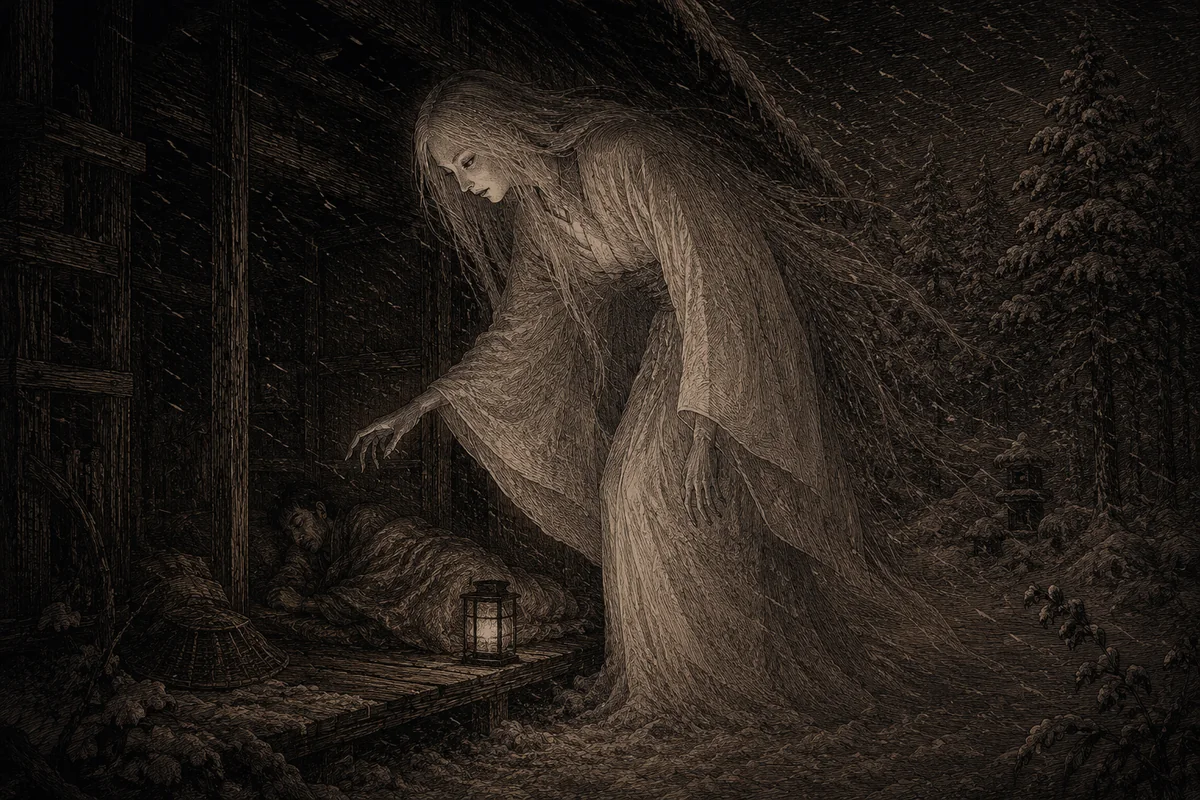
Yuki-onna — in the oldest text she is not the most beautiful young woman in a white kimono: she is a giantess with white hair, about three metres tall, encountered in Echigo.
- Variants and names
- 雪女 yuki-onna; 雪女郎 yuki-jorō; 雪婆 yuki-onba in Nagano and Ehime; 雪ん坊 yukinbo in Akita; つらら女 tsurara-onna in Niigata; しがま女房 shigama-nyōbō in Aomori
- What is told
- In the oldest text she is not the most beautiful young woman in a white kimono: she is a giantess with white hair, about three metres tall, encountered in Echigo. The regional oral traditions, collected between the late Edo period and the early twentieth century, are mutually incompatible: in Fukushima she is the spirit of freezing and whoever answers her dies of cold; in Iwate and Yamagata she drains the vital force of whoever opens the door to her; in Ōita she is almost vampiric; in Niigata she is a bride who melts if forced into a hot bath — and there the taboo is hot water, not the secret; at Tōno and at Hirosaki she appears with children in her arms, or asks that they be looked after. The version everyone knows — Minokichi spared in exchange for silence, O-Yuki wife and mother of ten children, the confidence broken, the departure — corresponds to none of these.
- What it was forthe author’s reading
- An aetiological tale of death from cold, in a belt of the country where the snow kills with regularity: whoever falls asleep dies, whoever opens the door dies, whoever answers dies. The female and most beautiful form is the way in which a cause of death becomes a figure with whom one can deal.
- Where it is attested
- Sōgi shokoku monogatari, book five, 1685: digitised copy at the Waseda University Library, collection ヘ13 04155. Lafcadio Hearn, Kwaidan: Stories and Studies of Strange Things, Boston, Houghton Mifflin, 1904. Studies: Makino Yōko of Seijō University; Hirakawa Sukehiro (ed.), Koizumi Yakumo jiten, Kōbunsha, 2000; Ōshima Hiroshi on the connection with the ubume. Reference record of the National Diet Library, query ID 1000310511.
- Caution
- It is read almost everywhere, Japanese Wikipedia included, that the first attestation is in a late Muromachi text by the renga poet Sōgi. The bibliographic record says otherwise: the Sōgi shokoku monogatari is an ukiyo-zōshi published in 1685, the work of Nishimura Ichirōemon known as Mitatsu, bookseller and writer of Kyoto, a commercial competitor of Saikaku. Sōgi is a frame character and the title is a fictitious attribution, used to sell. The yuki-onna thus loses about a hundred and eighty years of antiquity. As for the famous version: Hearn states that he had it from «a farmer of Chōfu, Musashi province» and adds «whether it has ever been written in Japanese I do not know». That source has never been found, and Makino Yōko maintains that no attestation of this narrative type earlier than 1904 exists: the many variants «very similar to Hearn» were collected afterwards. The monument erected in 2002 at Ōme proves nothing, because the inscription cites as proof Hearn's preface itself. The connection with peasant infanticide, which circulates as a key of interpretation, has no academic source: what is documented is the contamination with the ubume, the ghost of the woman dead in childbirth.
The grade says how well the entry is documented, not how interesting it is. How the grades are assigned.